
Life on site
Life on site
Working on a solar farm in Australia: what the job actually is
What utility-scale solar construction work involves day to day, who is on site, how the rosters and camps work, and what to look at before you take a job in regional Australia.
Utility-scale solar is construction work. That sentence does more to set expectations than anything else on this page, because most people arrive at it from the word "solar" and picture a technology job. On site it is closer to civil and mechanical construction: heavy plant, steel, dust, an early start, and a crew that has to hit a number of modules a day.
This guide describes what the work looks like, who is on site, and what is worth checking before you say yes. It does not tell you what you will be paid, whether a role counts towards anything on your visa, or which licence you need — those depend on the employer, the state and your own circumstances, and we point you to the official sources instead of guessing on your behalf.
What the work actually is
A utility-scale solar farm is built in phases, and the crew mix changes completely between them. It is worth knowing which phase a site is in when you apply, because it decides what you will be doing for the next six months.
Civil. Clearing, grading, access tracks, drainage, trenching for cable routes, and the fencing that goes around the whole array. This is where the excavators, dozers, graders and water carts live. It is the phase most like any other regional earthworks job.
Piling. Thousands of steel piles driven into the ground on a survey grid, each one the foundation of a tracker row. Pile-driving rigs run in a line down the array with a small crew each. It is repetitive, it is noisy, and it sets the pace of everything after it — if piling falls behind, so does the whole project.
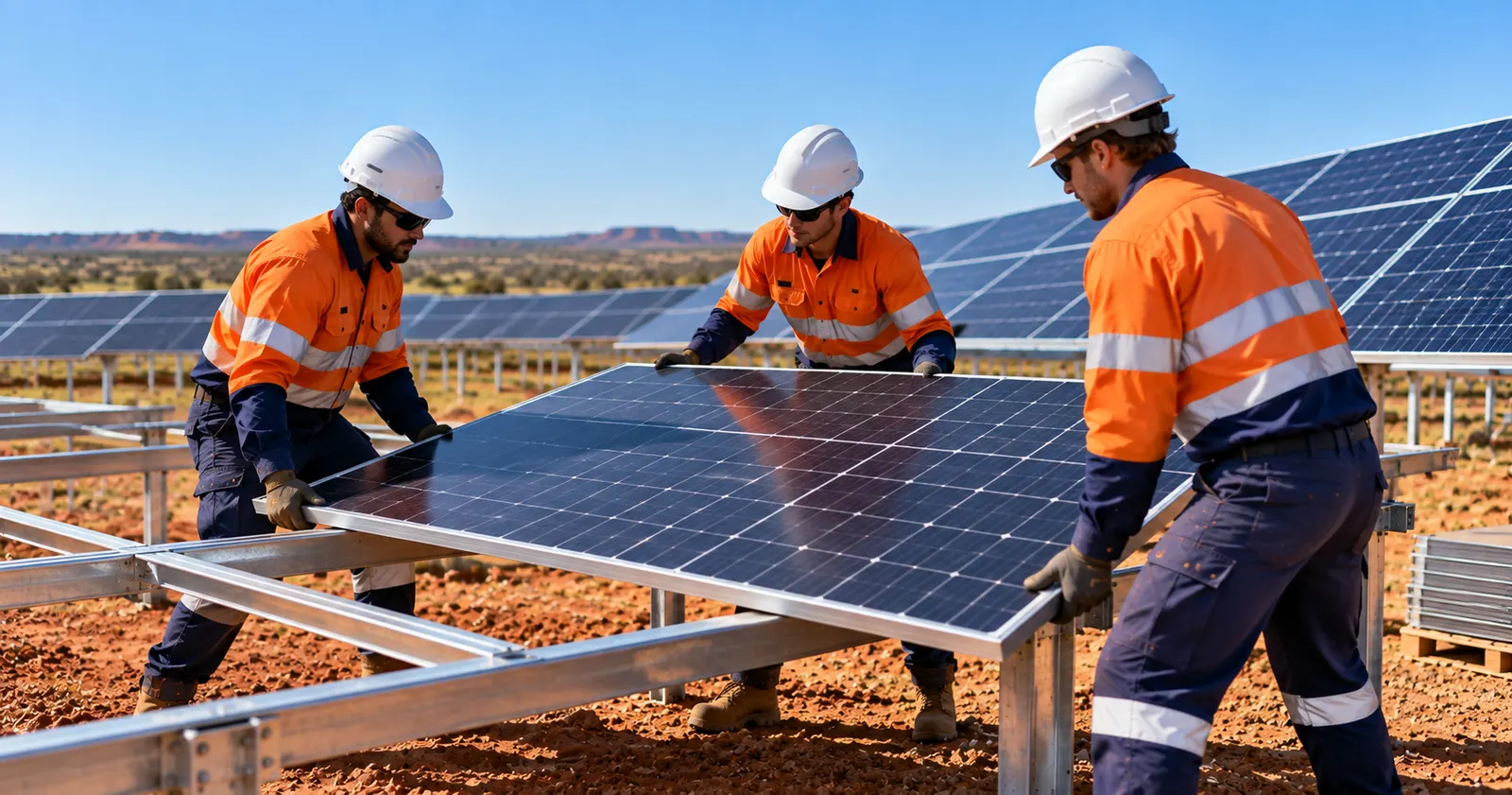
Mechanical. Torque tubes, bearings, drive motors and then the modules themselves. This is the phase with the largest headcount by a distance, and the one that hires the most people with no previous solar experience. Crews work in pairs or small teams down a row, and the day is measured in modules installed.
Electrical. DC string terminations, combiner boxes, inverter stations, medium-voltage reticulation, and the substation. Licensed work, done by licensed people, with trade assistants supporting them.
Commissioning and handover. Testing, fault-finding, defect rectification, and the paperwork that signs off each block. Smaller crews, more specialists, longer tails than anyone plans for.
Most job advertisements name the role rather than the phase, so read the description. A listing that talks about torque tubes and module install is a mechanical-phase job; one that talks about trenching and pads is civil.
Who is on site, and who actually employs you
The chain on a solar farm is longer than on most sites, and knowing where you sit in it explains a lot about how you get paid and who to talk to when something goes wrong.
At the top is the owner or developer, who holds the project. Below them the EPC contractor — engineering, procurement and construction — carries the build. The EPC then subcontracts packages: civil to one company, piling to another, mechanical install to a third, electrical to a fourth. Those subcontractors in turn often use labour-hire agencies to staff their crews.
So the name on the gate, the name on your induction, and the name on your payslip are frequently three different companies. None of that is unusual or improper — it is how large construction projects are staffed everywhere — but it matters for a practical reason: the entity that employs you is the one responsible for your pay, your entitlements and your records. Know which one it is before you start, and keep anything they give you in writing.
On this board the employer on a listing is the company doing the hiring, and where we have been able to check their Australian Business Number against the public register, the listing says so. That check tells you the business exists and is registered. It is not an endorsement of the role, the pay or the site.
You can see the employers currently hiring and, where a listing names one, the projects they are hiring for.
Rosters, camps and remote sites
Solar farms are built where the land and the grid connection are, which in Australia means regional and often remote. That shapes the working pattern more than the trade does. Where the farm is decides most of the rest — the roster, the room and the drive — which is why each regional guide starts with the place itself: solar farm jobs in the Pilbara, the Western Downs around Chinchilla, Dubbo and the west of New South Wales, the Sunraysia around Mildura and Port Augusta.
Rosters are usually compressed: a block of days on followed by a block off, rather than a five-day week. A listing that says "10 and 4" means ten days on site then four off. Longer swings are common on remote sites. The trade-off is real in both directions — the days on are long and consecutive, and the days off are genuinely free.
Accommodation takes several forms, and the difference between them is worth more than a couple of dollars an hour:
- Camp or workers village. A room on or near site, usually with meals provided. Some sites charge a nightly amount for it and some do not. Ask which, and ask whether it is deducted from pay.
- Accommodation provided. Motel-style or shared housing arranged by the employer.
- Allowance. A payment towards accommodation you arrange yourself. In a small town during a build, housing is scarce and the allowance may not cover what is available.
- FIFO. Fly-in fly-out, with flights and camp covered. Almost always a longer swing.
- Assistance. The employer will help you find somewhere. That is help, not a room.
Every listing on this board states which of those applies, because arriving in a town of four thousand people during a construction boom without somewhere to sleep is the single most common way a good job goes wrong in the first week. What each of those is like to live in, and what a listing does and does not promise with it, is its own article: solar farm camps and accommodation.
Heat is the other constant. Summer on an open array in inland Australia is severe, and sites run heat policies — early starts, extended breaks, sometimes a stand-down. Take them seriously and drink more water than you think you need.
What employers are actually looking for
For the entry-level roles — general hand, labourer, module installer — most employers are not looking for solar experience. Mechanical install in particular is taught on site, and the crews are built around pairing newcomers with someone experienced for the first weeks. What a solar farm labourer actually does, task by task and phase by phase, is its own article.
What they do look for is unglamorous and consistent:
- Reliability. Turning up, every day of the swing, on time. On a site where the crew size is planned to the person, one absence moves the whole day's target.
- Physical fitness for outdoor work. Heat, dust, repetition, standing all day.
- The tickets the role requires. Construction sites in Australia require a general construction induction card, known almost everywhere as the White Card, and it is state based. Other roles need machine tickets, height or electrical qualifications. Each listing on this board lists what it asks for.
- A driver licence, more often than not. Regional sites are not on a bus route.
- Working respectfully in a crew. Solar crews are mixed — backpackers, local tradespeople, people from three or four countries in the same team. It works when people make it work.
For the licensed trades the bar is different and specific: an electrician on a solar farm needs the licensing their state requires, and the employer will check it.
Browse by what you can actually do: labouring roles, trade assistant roles, plant operator roles, electrical roles or supervision.
Before you say yes
A short list of things worth having answered before you commit to travelling several hours to a regional town for a job:
- Who is the employer, legally — the name that will appear on your payslip.
- What is the pay, and on what basis — per hour, per day, per year — and what happens to overtime and to the hours on a compressed roster.
- What is the roster, and when does the first swing start.
- What is the accommodation, who arranges it, and what does it cost you.
- How do you get there, and who pays for that.
- How long is the engagement expected to last. A build has phases, and a phase ends.
- What tickets do you need before day one, and are any of them provided.
- What records will you be given — payslips, and a record of hours worked.
Anything an employer is unwilling to put in writing before you start is unlikely to become clearer afterwards.
Where to check the rules — and why we do not restate them here
This guide deliberately contains no pay rates, no visa criteria and no licensing requirements. That is not caution for its own sake. Those three things change, they differ by state, and they depend on your specific situation — and a page that states them confidently and goes out of date is worse than a page that sends you to the source.
General information only, not advice. For anything about your pay and entitlements at work, the Australian government's workplace regulator publishes the current position at fairwork.gov.au. For anything about a visa — which one you hold, what it permits, and what any extension of it requires — the Department of Home Affairs is the only source worth relying on, at immi.homeaffairs.gov.au. Licensing and construction induction requirements are set by each state and territory, so check the regulator for the state you will actually be working in.
If you are on a Working Holiday visa and wondering how solar farm work fits with it, we have written that up separately in the 88 days and solar farm work — with the same rule: what the question is, where to answer it, and nothing we cannot stand behind.
And if you would rather just look at what is open, start with every current opening or narrow it down by state.