

Life on site
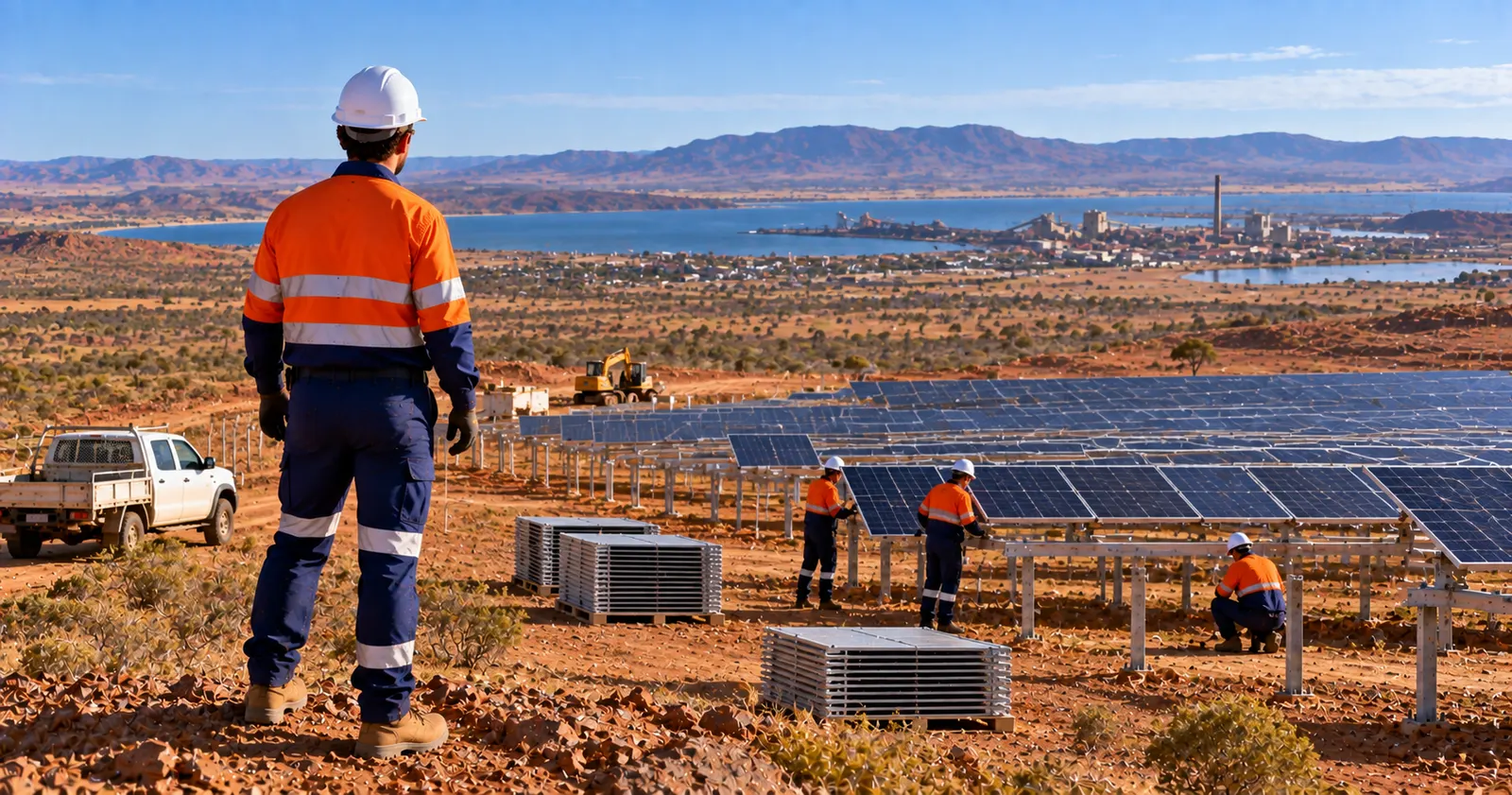
Life on site
Working on a solar farm around Port Augusta: the town, the climate, and what a roster means there
Port Augusta sits at the head of Spencer Gulf, where the farmland stops and the arid country begins. What it is like to live and work on a solar build in that part of South Australia — housing, heat, distance and rosters — and what this board is carrying for the State.
Port Augusta is where South Australia changes character. South and east of it there is farmland; north and west of it there is arid country and very long roads. The town sits at the head of Spencer Gulf, at the junction where the highways to Perth, to Darwin and to Adelaide separate, and it has been an energy and transport town for generations.
That is the short version of why solar construction crews keep turning up there. This article is about the other part: what it is actually like to be one of them. What the climate does to a working day, what housing looks like when a build is on, and what a roster means in a place where the nearest capital city is a long drive rather than a commute.
What is open right now, State-wide, is on the South Australian listings.
The geography, in the terms that matter to a crew
Three features of the place shape the work more than anything else.
It is the top of a gulf, not the coast. There is water, and it is not a beach town. The gulf narrows to a point at Port Augusta and the landscape around it is low, open and dry. Wind comes across it with nothing in the way.
It is a junction. The road and rail routes north and west meet here, which is why the town has more services than its size would suggest and why heavy transport is a normal part of the streetscape. For a construction project that means components arrive without heroics, and it means the town is used to a workforce that comes and goes.
It is the edge of the arid zone. Head north from Port Augusta and you are in country where towns are far apart and the trip between them is a planned trip rather than an errand. Sites in that direction are genuinely remote even when they look close on a map, and the distance is measured in hours of driving rather than in anything you can pace out.
The three other South Australian towns this board has carried listings for — Whyalla across the gulf, and Roxby Downs well to the north — sit on the same logic: industrial and mining towns with the infrastructure, the accommodation and the workforce habits that a large construction project needs.
The climate is the working condition
Port Augusta is hot and dry in summer and mild in winter, and both halves of that matter.
Summer runs the day. Heat on an open solar site with no shade is not a discomfort, it is a schedule. Early starts, planned breaks, water discipline and heat-stress procedures are normal parts of a summer roster, and they are the employer's obligation rather than your personal problem. Sites in this part of the country plan for it because they have to.
Dust and glare are permanent. Dry ground, wind and vehicle movement mean dust is a constant, and the glare off a landscape with no trees and a few hundred thousand pieces of glass is real. Eye protection is not a formality here.
Winter is genuinely pleasant to work in. Mild days, cold mornings, and the reason a lot of the physically hardest scopes get scheduled for the cooler half of the year where the programme allows it.
Working on a solar farm in Australia covers what a day on site is like in general terms; the difference in this part of South Australia is that the summer is longer and the shade is nonexistent.
Housing, and the question to ask before you accept
This is the practical thing people get wrong. A regional town has a normal amount of housing for a normal number of people. A construction project brings several hundred people who all need a bed on the same week, and the rental market and the motels absorb that or they do not.
So the question to ask an employer, before anything else, is what is provided:
- A camp — purpose-built accommodation, rooms and a mess, usually with meals. Common on larger and more remote builds, and the simplest arrangement for a worker who is not from the region.
- An allowance — you find your own bed and the employer contributes. Workable if you know the town, expensive if you arrive on the day and take what is left.
- Nothing — the role is treated as local. Fine if you live there; a problem if you do not, and it is the arrangement that catches people out.
Of the South Australian listings published on this board in August 2026, all six declared accommodation of some kind rather than leaving it to be discovered. That is a fact about those six listings on that day, not a rule about the region, and it is exactly the field to read on a listing page before the pay figure.
What a roster means when the capital is a drive away
Adelaide is reachable from Port Augusta by road in a way that Perth is not from the Pilbara, and that single fact changes the shape of the rosters offered here. Two patterns are common:
Drive-in drive-out. Compressed rosters — a stretch of long days, then a block off — with workers driving up from Adelaide or from towns in the mid-north at the change of swing. It is cheaper for an employer than flights and it is why a South Australian solar roster often looks like a mining roster with a car instead of a plane. The same Adelaide catchment reaches east across the border to Mildura and the Sunraysia, which is why that guide reads so much like this one.
Local and near-local. A share of the workforce lives in the region already, works a more conventional week, and goes home at night. This is the part of the workforce a project most wants to grow, because it does not have to be housed.
FIFO and DIDO on Australian solar builds sets out what those roster patterns mean for your pay, your fatigue and your life off swing. The specific thing to weigh here is the drive itself: a long highway trip at the end of a long swing is a real risk and a real cost, and it is worth asking who is paying for the travel time and how the change of swing is scheduled.
What this board was carrying for South Australia
Queried on 17 August 2026, six listings were published for South Australia — three of them at Port Augusta itself, two at Whyalla and one at Roxby Downs. Across the State the trades were two labouring roles, one plant role, one electrical role, one trade assistant role and one supervision role.
Five of those six quoted a rate by the hour, and those five advertised between AUD 34.00 and AUD 96.00 an hour. That is a wide band because it spans a first-day labouring rate and a licensed technical role, it is what these employers wrote on one day, and it is not a market average. What solar farm jobs pay explains what sits inside a figure like that and what does not.
Three of the six declared themselves eligible towards the 88 days. The 88 days and solar farm work is the article that explains that condition properly; the short version is that eligibility depends on the postcode, the industry and the arrangement, and it is the employer who declares it.
The current list, which is the only version of these numbers that is never out of date, is the South Australian listings.
If you are thinking about going
Three honest pieces of advice for this region in particular.
Sort the White Card before you move, not after. It is the one thing every construction listing here asks for and it is the cheapest item on the list. Tickets for solar farm jobs goes through what else is worth holding, by trade.
Do not arrive without a confirmed bed. The housing paragraph above is the whole reason. Arriving in a regional town during a build with a plan to "find something" is how a good job becomes a bad month.
A vehicle is close to compulsory. Sites are outside town, public transport does not go there, and a good number of listings ask for a driver's licence for that reason alone.
If you have never worked on a construction site, solar farm jobs with no experience is the place to start, and trades, pay and tickets on utility-scale solar sets out which trades a build actually uses.
General information only. Heat policies, site rules, accommodation arrangements and visa eligibility are set by each employer and by the relevant regulators, and they change. Nothing here replaces what a listing declares. For pay and conditions the national source is fairwork.gov.au, and for visa conditions it is immi.homeaffairs.gov.au.