
Life on site
Life on site
Working on a solar farm around Mildura and the Sunraysia: an irrigated corner with a very long summer
Where Victoria, New South Wales and South Australia meet on the Murray, the Sunraysia is irrigated horticulture in dry country. What it is like to live and work on a solar build there — the seasons, the competing harvest workforce, the housing — and what this board is carrying for Victoria.
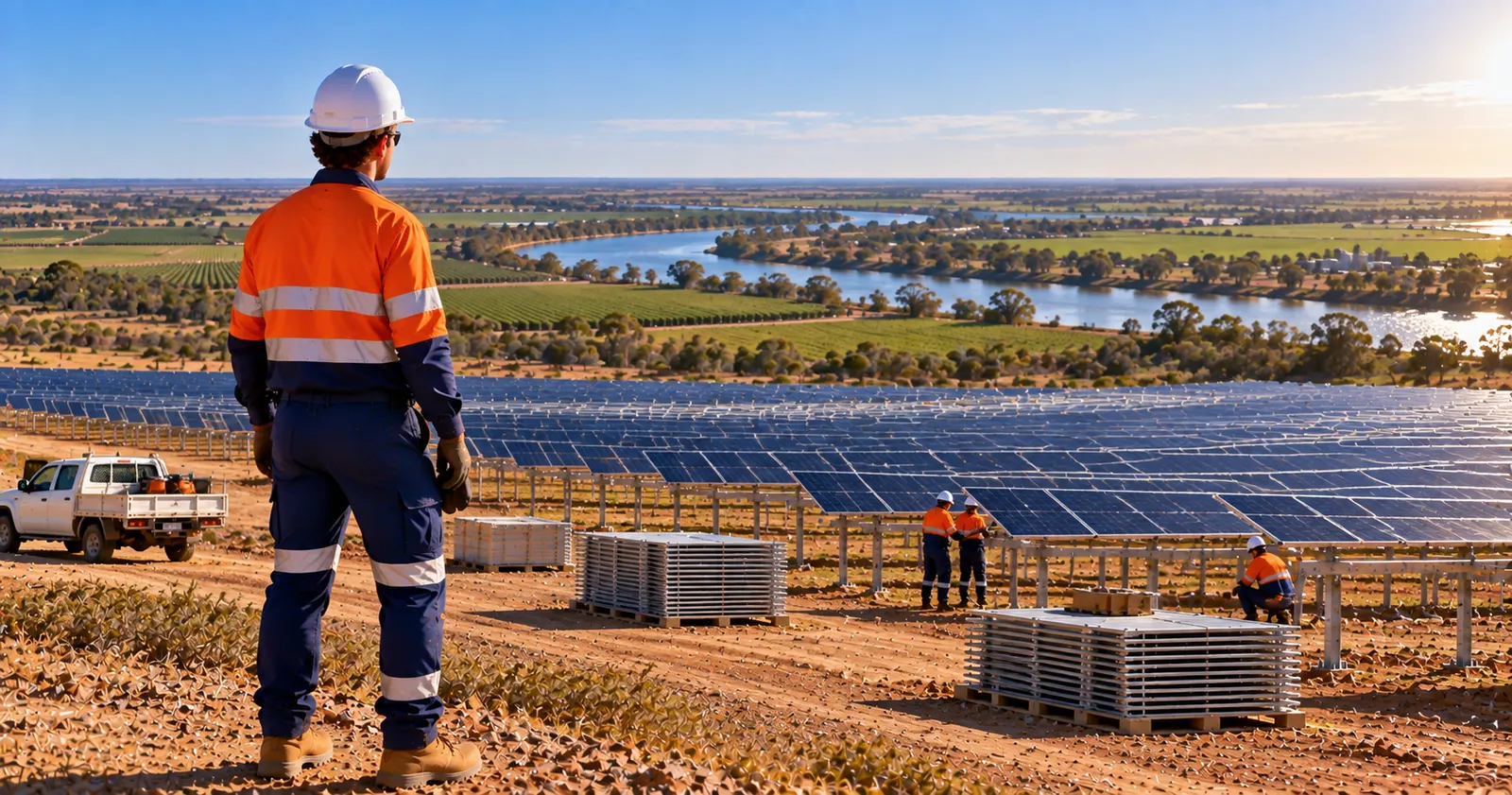
The Sunraysia is an unusual place: an intensely green, irrigated horticultural district sitting in dry country, strung along the Murray where three States meet. Mildura is its centre — a substantial regional city with an airport, a hospital and a full set of services — and the region around it grows fruit, grapes and almonds on water pumped out of the river.
Solar construction and that landscape fit together for reasons that are easy to see from the ground: flat land, a great deal of sun, and a farming economy already used to seasonal workforces arriving and leaving. This article is about what it is like to work a build there. What is open now, State-wide, is on the Victorian listings.
Irrigated country, and what that means on site
The Sunraysia is dry country made green by irrigation, and both halves of that description show up in your working day.
The dry half. Long hot summers, low rainfall, dusty ground and very open sky. This is closer to the South Australian experience than to the Victorian one most people imagine: the Melbourne weather that Victoria is known for is a long way south of here.
The irrigated half. Vines, orchards and almond plantations, packing sheds, and a road network built around them. It also means a seasonal labour market that already exists and that a construction project competes with — for beds, mostly, and sometimes for people.
Mildura itself is comfortable to be based in by regional standards. The other Victorian towns this board has carried listings for spread the picture out: Swan Hill and Kerang further down the Murray, Bendigo in the goldfields country to the south, and Horsham out on the Wimmera plains, which is grain country and drier again.
The summer is the whole planning question
Two things collide in a Sunraysia summer and it is worth seeing them together.
Site heat. Long stretches of hot, dry days on ground with no shade. The procedures are the familiar ones — early starts, planned breaks, hydration discipline, heat-stress rules that are the employer's obligation — and they are needed for more of the year here than in most of Victoria.
Harvest. The horticultural season brings its own influx of workers into the same towns. Where the peaks overlap, the pressure on rentals, caravan parks and motels is worse than either would produce alone. If you are arriving in the region without accommodation provided, the season you arrive in is a real variable in what it costs you.
Winter is cool, sometimes foggy, and short in the way inland winters are. Working on a solar farm in Australia describes the day itself.
Housing, and the harvest overlap
Mildura has a genuine rental market and a full accommodation industry, which puts it ahead of most towns in this corpus. It also has a horticultural workforce that uses that industry heavily for part of the year.
The questions to ask an employer are therefore the usual three, with one regional edge:
- A camp, if the build is large or the site is well outside town. The simplest answer and the one that removes the harvest variable entirely.
- An allowance, which is workable in Mildura and less so in the smaller towns nearby.
- Nothing, meaning the role is treated as local — which in this region is a genuine possibility rather than a formality, because there is a real local workforce.
Of the Victorian listings published on this board in August 2026, five of eight declared accommodation of some kind. That was the lowest proportion of any State on the board that day, and it is consistent with a State where more of the work sits within reach of towns people already live in. It is a fact about those eight listings on that day rather than a rule about Victoria.
Rosters, and the three-State corner
The Sunraysia sits at a border corner, and the practical effect is that the labour catchment for a build here is not one State. Crews come up from Melbourne and Adelaide, across from the Riverina, and out of the region itself, and the roster offered usually reflects which of those the employer is recruiting from. The New South Wales side of the river — Wentworth, Balranald and the Riverina beyond — is covered by the guide to Dubbo and western New South Wales.
Expect to see the full range: compressed drive-in drive-out swings for people travelling from a capital, more conventional weeks for local hires, and camp-based rosters on the larger and more remote sites. FIFO and DIDO on Australian solar builds covers what each does to your pay and your time, and the questions to ask about travel time and the change of swing.
One border detail worth knowing rather than guessing: licensing, tickets and some site rules are set by State and Territory regulators, so a site on one side of the river and a site on the other can differ in the administrative details even when they look identical. Ask, and ask the regulator rather than a forum.
What this board was carrying for Victoria
Queried on 17 August 2026, eight listings were published for Victoria. Two were at Mildura, two at Kerang, two at Bendigo, and one each at Swan Hill and Horsham.
The trade mix was three labouring roles, two trade assistant roles, one plant role, one electrical role and one supervision role — the highest trade assistant share of any State on the board that day, which is a mechanical-phase signature: a trade assistant is the role that multiplies around module and structure installation. Career progression on solar farms sets out where that role sits and where it leads.
Seven of the eight quoted an hourly rate, and those seven advertised between AUD 34.00 and AUD 74.00 an hour — what these employers wrote on one day, not a market average. What solar farm jobs pay unpacks what a band like that contains.
Four of the eight declared themselves eligible towards the 88 days; the condition is explained in the 88 days and solar farm work, and it is declared by the employer rather than by the board.
The live list is the Victorian listings.
If you are heading to the Murray
Check the season you are arriving in. It is the one piece of regional knowledge that will save you money here, and it applies to accommodation more than to anything else.
Do not assume Victorian weather. The Sunraysia in January is not Melbourne in January, and people pack for the wrong State.
Hold the White Card before you arrive, and read tickets for solar farm jobs for what else is worth holding in the trade you are aiming at. If you have never worked on a site, solar farm jobs with no experience is the starting point, and trades, pay and tickets on utility-scale solar sets out which trades a build uses.
Ask which State's rules apply. At a border corner it is a sensible question rather than a pedantic one.
General information only. Site rules, heat policies, accommodation arrangements, licensing and visa eligibility are set by employers and by regulators and they change. Nothing here replaces what a listing declares. For pay and conditions, see fairwork.gov.au; for visa conditions, immi.homeaffairs.gov.au.