

Trades and careers
Trades and careers
Solar farm jobs with no experience: which roles take entrants, and what a site requires
The two occupation families that regularly take people with no previous solar work, the induction card nothing substitutes for, what counts as experience when you have none of the right kind, and what an application should contain.
Most people on a utility-scale solar build had never been on one before they started. That is not encouragement, it is the structure of the work: a solar farm needs a large crew to carry, place and bolt hundreds of thousands of components, and the skill that matters most in that crew is showing up able to work and able to be told things.
So "no experience" is the wrong question to ask about a solar farm job. The right questions are: which family of work takes an entrant, what does a site require before it lets you through the gate, and what does an application need to contain so that a recruiter can act on it. This article answers those three, and nothing on this page tells you how long anything takes or promises you a position.
The two families that take entrants
Of the five occupations this board files work under, two regularly appear without a requirement for previous solar work.
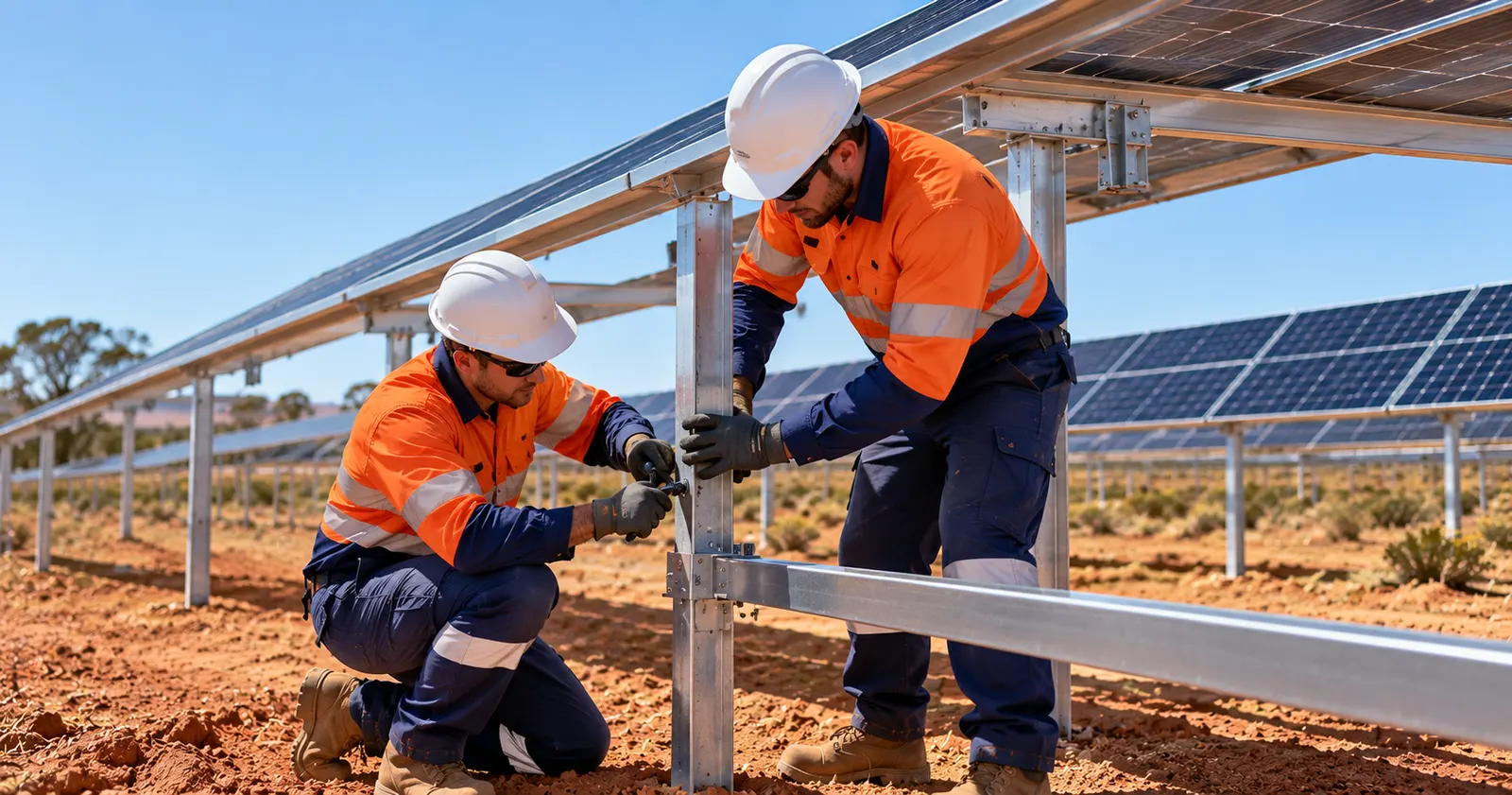
Labourer, or general hand. The largest group by headcount on almost every build. Unloading and distributing modules, module installation, torquing structures, fencing, housekeeping, traffic control inside the array, and whatever the day needs. Of the listings published on this board in August 2026, 13 were labouring roles — the single largest family on the board — and all 13 were on projects in regional postcodes. See labouring roles. That list of tasks is a job in itself, and what a labourer does on a solar farm, from the prestart to pack-down, has its own article.
Trade assistant. Paired with a tradesperson, mechanical or electrical, doing the work that supports theirs: cable pulling, string dressing, preparing skids, tool and consumable control. It asks for more than labouring does — reliability that somebody has already observed, usually — and it is the ordinary next step out of it. How that step actually happens is its own short guide — it is granted on site, not by a ticket. See trade assistant roles.
The other three families are gated by something you cannot substitute for with willingness. Plant operator needs current high risk work licences and, in practice, hours on the machine. Electrician needs the licensing your state requires — this is the one where "close enough" does not exist. Supervision is a role you are given after a site has watched you work.
What a site requires before it lets you in
The distinction that costs entrants the most is between what makes you employable and what makes you inductable. An employer can decide to take a chance on you. Nobody can decide to let you onto a construction site without a construction induction card.
The White Card is the floor. Australia's general construction induction card is required on construction sites nationally, issued through registered training organisations, and administered state by state. It is the credential that appears on nearly every listing here, because without it you cannot be inducted. It is short, it is cheap relative to everything else in this article, and it is the one thing to sort out before you start applying rather than after.
Current is a real word. A certificate that has lapsed is treated as no certificate at all, and the check happens at the gate rather than after you have driven six hours.
A driver's licence is close to mandatory in practice. Not because the job is driving, but because the site is 20 to 40 kilometres from the town you sleep in and no bus goes there.
Then the ones that depend on the role. Working at heights, elevating work platform, first aid, low-voltage rescue. These are asked for by an employer or a project rather than being a universal requirement, and the listing says which. Do not buy a stack of them speculatively before you have read what is actually being asked; our guide Trades, pay and tickets sets out what each credential is and who issues it.
What counts as experience when you have none of the right kind
Recruiters on a build are reading for evidence of three things, and none of them require a solar farm.
That you have done physical work in heat. Farm work, warehouse work, landscaping, concreting, hospitality on your feet for ten hours — all of it is evidence. An array in February is hot, exposed and dusty, and an employer's real worry about an entrant is that they will last four days.
That you turn up. Any reference from any job who can say "was here at the time they said, every day" is worth more than a course certificate. Name them, with their role, and check first that they are willing.
That you can be told things. Solar construction is repetitive work executed to a tolerance, under a supervisor, in a crew. A site is not looking for initiative in the first week; it is looking for someone who does the thing the way the prestart said to do it.
What is not evidence, and is worth saying: a general interest in renewable energy. Every applicant writes it. It distinguishes nobody.
What to put in the application
Short, factual, and specific to the listing. The three things a recruiter checks first are the ones most applications leave out.
- Your tickets, by name, with their currency. "White Card, issued 2026" rather than "relevant tickets".
- Your availability, as a date. Not "immediately" — a date. Mobilisation on a build is planned, and a crew that starts on the 14th needs people who can be there on the 14th.
- Where you will live. If the listing offers a camp, say you accept camp. If it offers nothing, say where you will be staying. Accommodation near a regional build is the reason otherwise-good applications fall over, and an applicant who has already solved it is visibly easier to hire.
- Your work rights, stated once. If you are on a visa, name it and name its conditions. Do not make an employer guess, and do not overstate it.
- A CV that is one file and two pages. Roles, dates, locations, tickets. No photograph, no design.
If you are here on a Working Holiday
Solar farm work in a designated regional area can count towards the 88 days of specified work that a second Working Holiday visa requires. On the listings published on this board in August 2026, 19 of 38 were flagged as being on projects in a postcode eligible for that purpose, and every one of the 13 labouring roles was among them. You can filter the board by that flag directly: eligible listings.
This is an attribute of the offer, not of you. A postcode is eligible or it is not; what counts for your own application is decided by the Department, on the evidence you keep. Our guide The 88 days, the Working Holiday visa and solar farm work covers what evidence to keep and what the traps are.
What entry-level roles were advertising
Facts rather than an estimate, and dated so you can see when they were true.
On the listings published on this board in August 2026, labouring roles advertised hourly rates between $34.00 and $46.00, and trade assistant roles between $36.50 and $47.00. Those are the advertised bands on this board on that date, in Australian dollars, not a market average and not an entitlement. The figure a particular offer pays depends on the award or agreement it sits under, the roster, and what the employer wrote. What solar farm jobs pay breaks the same query down by family and explains what the numbers do and do not include.
Where to go from here
Read Working on a solar farm in Australia for what the day itself is like, and Solar farm construction jobs for which phase of a build is hiring which trade — the entry-level families are wanted at specific moments, and knowing which one a project is in tells you a great deal about whether your application lands at a useful time. Then read the labouring listings themselves: the requirements section of a real advertisement is more informative than any article about applications.
General information only. Induction and licensing requirements are set by each state and territory and they differ; check the regulator for the state you will actually work in. For pay, work rights and conditions, the national source is fairwork.gov.au. For visa questions, the only source that counts is immi.homeaffairs.gov.au.