
Trades and careers
Trades and careers
Plant operator work on a solar farm: which machine, which phase, which ticket
Piling rigs, telehandlers, rollers and water carts. What plant operators actually do on a utility-scale solar build, which machine belongs to which phase, and the difference between a high risk work licence and a verification of competency.
Plant is the trade on a solar build where the machine decides the job. A site runs different iron in every phase, the crews follow the iron, and an operator who knows which machine belongs to which part of a project can read a listing and tell you what week the site is in.
This article is about that: what the machines are, when each one is wanted, and what a site asks you to hold before it puts you on one. What is open right now is on the plant listings.
The machines, in the order a site uses them
A solar build moves through four phases, and each one has its own iron. Solar farm construction jobs describes the phases properly; this is the plant seen from the seat.
Earthworks and access. Graders, dozers, excavators, rollers, water carts, articulated dump trucks. Roads, pads, drainage and the internal tracks that everything else will use for a year. This is conventional civil work and it is where operators with civil experience find the site most familiar.
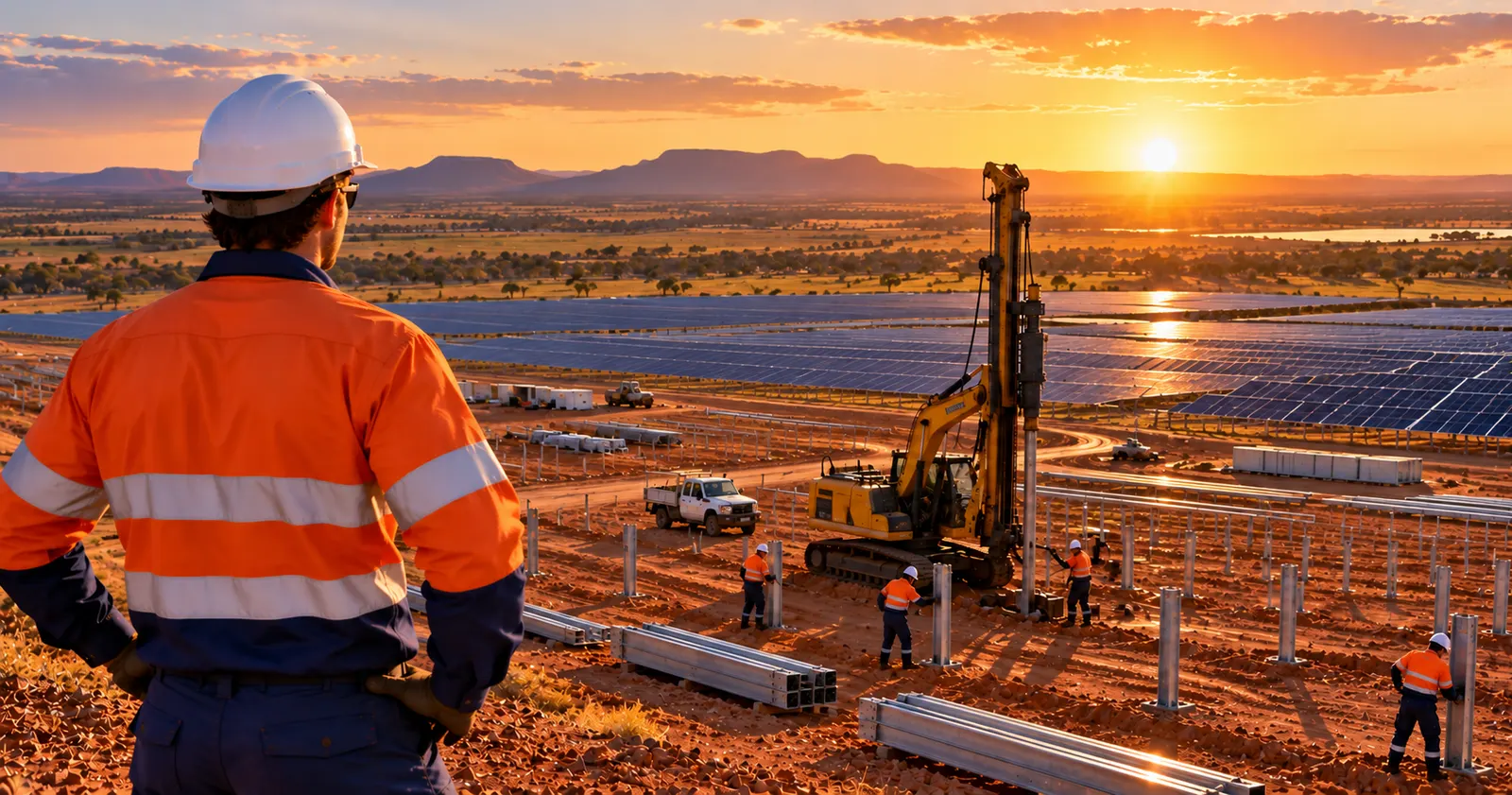
Piling. The signature machine of a solar farm. Thousands of steel piles are driven into the ground on a survey grid, at a rate that makes it a production line rather than a construction task. A piling rig operator on a good day is a rhythm, a spotter and a tolerance. There is nothing else quite like it in civil construction, and it is the most sought-after seat on an early site.
Mechanical. Telehandlers above all — module and torque tube delivery to the rows, all day, in dust — plus forklifts in the laydown yard, and elevated work platforms wherever people need to be off the ground. The mechanical phase is the headcount peak of the whole project and it is where most plant hours are.
Electrical and commissioning. Fewer machines and more precision: cranes and franna-type mobile cranes for inverter stations and transformers, excavators for trenching, elevated work platforms for terminations and for the substation. Small crews, high consequence lifts.
All the way through: water carts, because dust suppression on a site measured in kilometres is a permanent job, and a skid steer or tool carrier that does the work nobody budgeted for.
The ticket question, and the distinction nobody explains
There are two different kinds of paper for operating plant in Australia and they are constantly confused.
High risk work licences. A national scheme, administered by the State and Territory regulators, covering classes of work assessed as high risk — forklift, boom-type elevated work platforms above a threshold height, cranes, dogging and rigging among them. These are licences: assessed, issued, carried, renewable.
Verification of competency, and statements of attainment. Most earthmoving machines — excavator, dozer, roller, grader, skid steer — are not covered by a high risk work licence class. Competence is demonstrated through nationally recognised training units and then confirmed by the employer, on that machine, on that site, before you operate it. A VOC is not a licence and it does not transfer automatically to the next employer, who will usually want their own.
Two practical consequences:
- "Tickets" on a plant listing can mean either. Read the listing rather than assuming.
- Expect to be assessed again on arrival even when you hold everything. It is not a judgement on you; it is how the second category works.
On the listings published on this board in August 2026, all seven plant roles asked for a White Card and a driver's licence, four asked for a forklift ticket, two for an elevated work platform ticket and one for a heavy rigid or multi-combination licence. Tickets for solar farm jobs goes through the whole board's requirements, trade by trade.
The driver's licence is not a formality here
Seven of seven plant listings wanted a driver's licence, and it is the one requirement people underestimate because it sounds administrative. On a regional build it is not: you get yourself to site, you move between work fronts across a site that is kilometres end to end, and a good number of plant roles involve driving something registered on a public road to get plant or water where it is needed.
Heavy vehicle classes are a genuine multiplier. One listing in August 2026 asked for a heavy rigid or multi-combination licence outright, and a water cart or float driver who also operates is two roles in one person, which is exactly what a site short of people wants.
What the work is actually like
Honest version, because the machine hides some of it:
- It is production work. Piling and module delivery are measured in units per day. The pressure is rhythm, not difficulty, and the difference between a good operator and an average one shows up in the daily count rather than in any single movement.
- You are never alone even when you feel it. Spotters, ground crew and the people walking the rows. Most of the real skill on a solar site is awareness of people around a machine in a landscape with no walls and a lot of noise.
- Dust, heat and glare. A cab helps and does not solve it. Working on a solar farm in Australia describes the day as a whole.
- Rosters and travel. Plant follows the phase, which means the roster follows the phase too. FIFO and DIDO on Australian solar builds covers what camp, allowance and fly-in fly-out actually mean on these projects.
- Maintenance is part of the seat. Prestart checks, greasing, reporting a fault you could have ignored. Operators who look after iron are the ones who get the good machine next time.
What it was advertised at
The seven plant roles published on this board, queried on 17 August 2026, advertised between AUD 44.00 and AUD 64.00 an hour. That put the bottom of the plant band about ten dollars an hour above the bottom of the labouring band on the same day, which is the clearest financial argument for machine tickets that this board can make.
It is a snapshot of what these employers wrote, not a market rate and not an offer, and it says nothing about what is inside the figure. What solar farm jobs pay unpacks that, and trades, pay and tickets on utility-scale solar sets plant beside the other trades.
Getting into a seat if you are not in one
The common route is not a course. It is labouring on a civil crew, being useful around the machines, being trusted with a small one, and accumulating the hours that make a VOC believable. Career progression on solar farms sets out where that sits on the ladder, and solar farm jobs with no experience is the article about getting onto the site in the first place.
If you already operate in civil, mining or agriculture, most of what you have transfers. What does not is the density of people on foot around the machines during the mechanical phase, and that is the thing to be humble about in your first fortnight.
Browse the plant listings and read the ticket list before the rate: it tells you which machine the site is actually short of.
General information only. High risk work licence classes, verification of competency requirements, heavy vehicle licensing and site rules are set by State and Territory regulators and by each employer, and they change. Nothing here is a substitute for what a listing declares or a regulator publishes. For pay and conditions, the national source is fairwork.gov.au.
Read next
Trades and careers
Career progression on solar farms: the rungs, the forks and what each one is paid
Trades and careers
Electrical work on Australian solar farms: what the trade is, and how it differs from building work
Jobs by trade
Every Plant Operator opening
Articles