
Trades and careers
Trades and careers
Trades, pay and tickets on utility-scale solar
The five job families on an Australian solar farm, what each one does, which tickets sites ask for, and how to read a pay figure on a job advertisement without guessing.
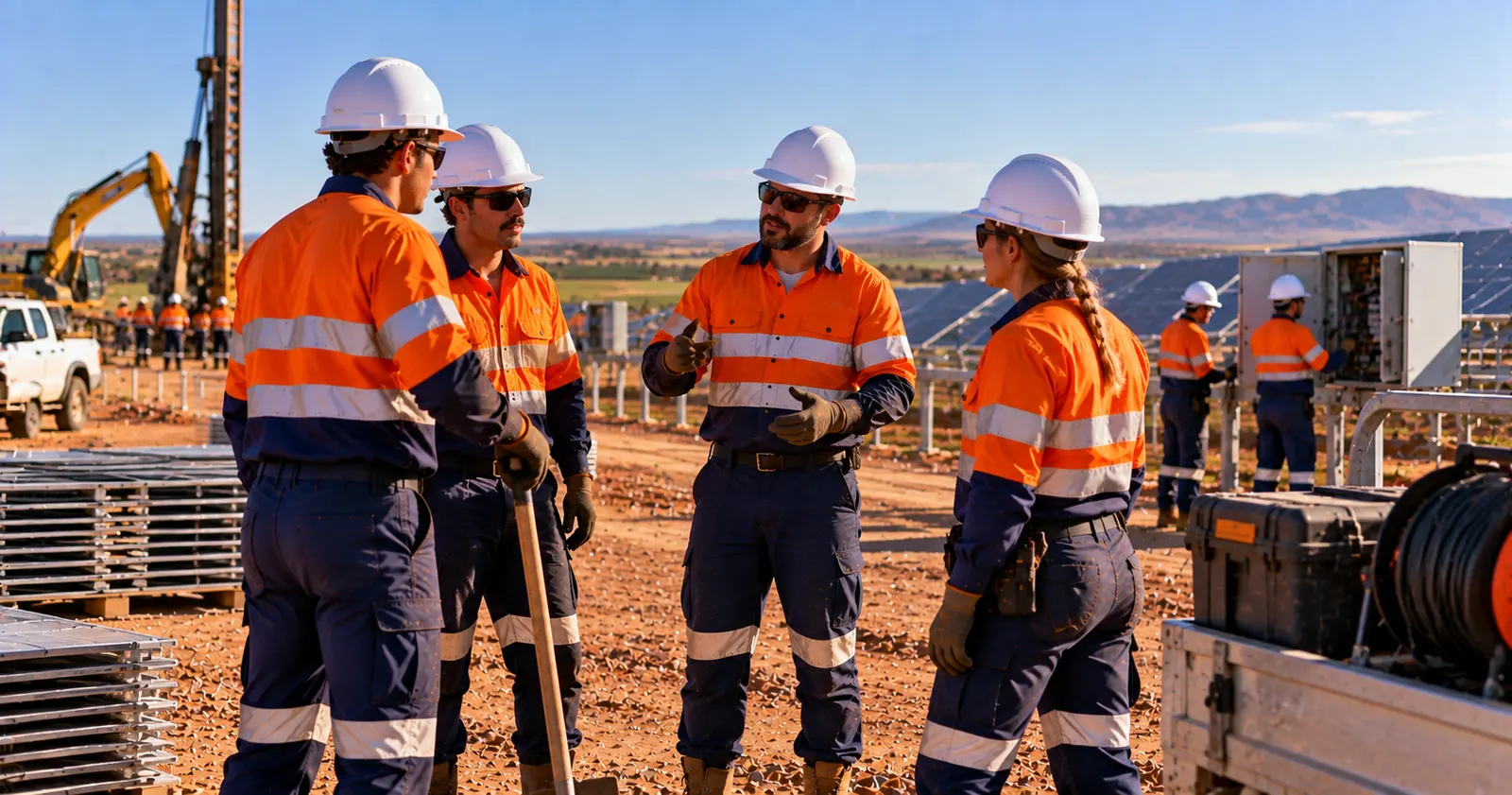
"Solar jobs" covers work that has almost nothing in common from one role to the next. A module installer and a high-voltage electrician are on the same site, under the same project, and are doing entirely different jobs with entirely different entry requirements.
This guide sets out the job families you will actually see advertised, what each one does, what sites typically ask for, and how to read a pay figure on an advertisement. It does not tell you what any role pays or what any licence requires — those are set by awards, agreements and state regulators, and we point you at them rather than restating them.
The five job families
Every listing on this board is filed under one of five occupations. They are broad on purpose: a site has a hundred job titles and about five kinds of job.
Labourer / general hand. The largest group by headcount on almost every build. Unloading and distributing modules, module installation, bolting torque tubes, fencing, housekeeping, traffic control inside the array, and whatever the day needs. This is the family that most often takes people with no previous solar experience. See labouring roles.
Trade assistant. Paired with a tradesperson — mechanical or electrical — doing the work that supports theirs: cable pulling, string dressing, preparing skids, tool and consumable control, and the fetching and carrying that keeps a licensed person doing licensed work. A common route from labouring into a trade. See trade assistant roles.
Plant operator. Telehandlers, excavators, skid steers, water carts, and the pile-driving rigs that set the tracker foundations. Ticketed work, and the tickets have to be current and verifiable. Experience on rough regional terrain is what separates a shortlist. See operator roles.
Electrician. DC string termination and testing, combiner and inverter work, medium-voltage cable work, commissioning, and the test paperwork that goes with each block handover. Licensed work, and the licensing is set by the state you work in. See electrical roles.
Supervision. Leading hands, site supervisors, project supervisors. The daily prestart, permits and job safety analyses, crew allocation across blocks, progress against the inspection and test plan, subcontractor coordination, and the safety conversations nobody else wants to have. Usually salaried rather than hourly. See supervision roles.
Tickets, licences and what the difference is
Australian construction uses "ticket" loosely for several different kinds of credential, and they are not interchangeable.
Construction induction. Every construction site in Australia requires a general construction induction card — universally called the White Card. It is issued through registered training organisations and is administered state by state. It is the single credential that appears on almost every listing on this board, because without it you cannot be inducted onto site.
High risk work licences. Machine and activity licences — forklift, elevating work platform, rigging, and so on. Nationally recognised classes, issued by state regulators.
Electrical licensing. Regulated separately again, by each state and territory, and this is the one where "close enough" does not exist: a person doing electrical work without the licensing that state requires is a legal problem for them and for the employer.
Certificates that are not licences. First aid, CPR, low-voltage rescue, working at heights. Frequently required by an employer or a project even where no law demands them.
Overseas qualifications. Whether a qualification you hold from another country is recognised in Australia — and what the process to have it assessed is — is a real question with a real answer, and the answer is not on this page. It depends on the qualification, the state and the occupation.
General information only. Licensing and induction requirements are set by each state and territory, and they differ. Check the regulator for the state you will actually work in — not the one you are currently standing in. For work rights, pay and conditions, the national source is fairwork.gov.au. For anything visa related, immi.homeaffairs.gov.au.
Every listing on this board states the tickets it asks for. Where a listing says White Card and construction induction, that is the employer's requirement for that role — not a general rule about the trade.
How to read a pay figure without guessing
This board shows the pay on every listing where the employer supplied it, and refuses "salary on request" as a matter of policy. That still leaves you with the work of reading the figure properly, and a headline number can mean quite different things.
Know the unit. A rate quoted per hour, per day, per week and per year are not comparable by eye. When you sort by salary here, the sort converts everything to a full-time annual equivalent before comparing, on a 38-hour week over 52 weeks — otherwise every annual listing would sit above every hourly one for no reason but the size of the number. That is this site's assumption for ordering, stated so you can disagree with it; it is not a claim about your actual hours.
Know what a range means. "34 – 38.50 an hour" is a band, usually reflecting experience or a leading-hand step. The number you are offered is the number that matters.
Ask about the hours the roster actually produces. A compressed roster means long consecutive days. How those hours are treated — ordinary, overtime, penalty rates, or an annualised arrangement — depends on the instrument that covers the job.
Ask what is deducted. Camp accommodation is sometimes charged per night, sometimes not. A listing here states which where the employer told us.
Ask what is on top. Living-away allowances, site allowances and travel are common in regional construction and are not always in the headline rate.
Casual is a specific thing in Australia, with no guaranteed hours and, ordinarily, a loading in exchange. It is not the same as part-time, and a casual role can be full-time hours.
What none of that answers is whether a given figure is lawful or correct for the work. That question belongs to the award or agreement covering the job, and to fairwork.gov.au, which publishes the current position and a pay calculator. We deliberately do not restate rates here: they change, they differ by classification, and a stale number on a job board is worse than no number at all.
Moving from one family to the next
The usual path on a solar build is unglamorous and works: labourer, then trade assistant, then either a machine ticket into operating or a formal apprenticeship into a trade. What moves people along it is not applying for a better title — it is being on site, being reliable, and being the person a leading hand asks for.
Two things speed it up. The first is tickets: a machine licence obtained while you are already on site and known to the crew is worth more than the same licence obtained cold. The second is staying for a whole phase. Builds run in blocks with progress claims and handovers, and the people who are still there at handover are the ones who get asked to the next site.
Supervision is a different jump, and the listings say so plainly: prior supervision on a solar or heavy civil site is usually a requirement rather than a preference.
Where to start on this board
If you have no construction experience: labouring roles, and read what the work actually is first so the roster and the camp are not a surprise.
If you are on a Working Holiday visa: the 88 days guide, then openings flagged as 88-days eligible.
If you have tickets already: filter by trade — operator, electrician — or look at where the work is by state.
If you would rather look at the sites themselves, the solar projects behind these listings show the capacity, the stage of construction, and who is hiring on each one.