
Trades and careers
Trades and careers
Electrical work on Australian solar farms: what the trade is, and how it differs from building work
Licences, high voltage, the tickets that travel with them, and the one thing about a solar array that no electrician who has only worked in buildings expects. What the work is on a utility-scale build.
An electrical licence is transferable to a solar farm. The habits of building work are not. This is an article about what the trade actually consists of on a utility-scale solar build, written for licensed people considering the move and for apprentices working out whether it is where they want to end up.
It is not a list of openings. What is open right now is on the electrical listings, which is where the roles, the States and the current rates are.
What the electrical scope on a solar farm actually is
A solar farm is an electrical machine the size of a suburb, and the electrical work on it divides into three worlds that barely resemble one another.
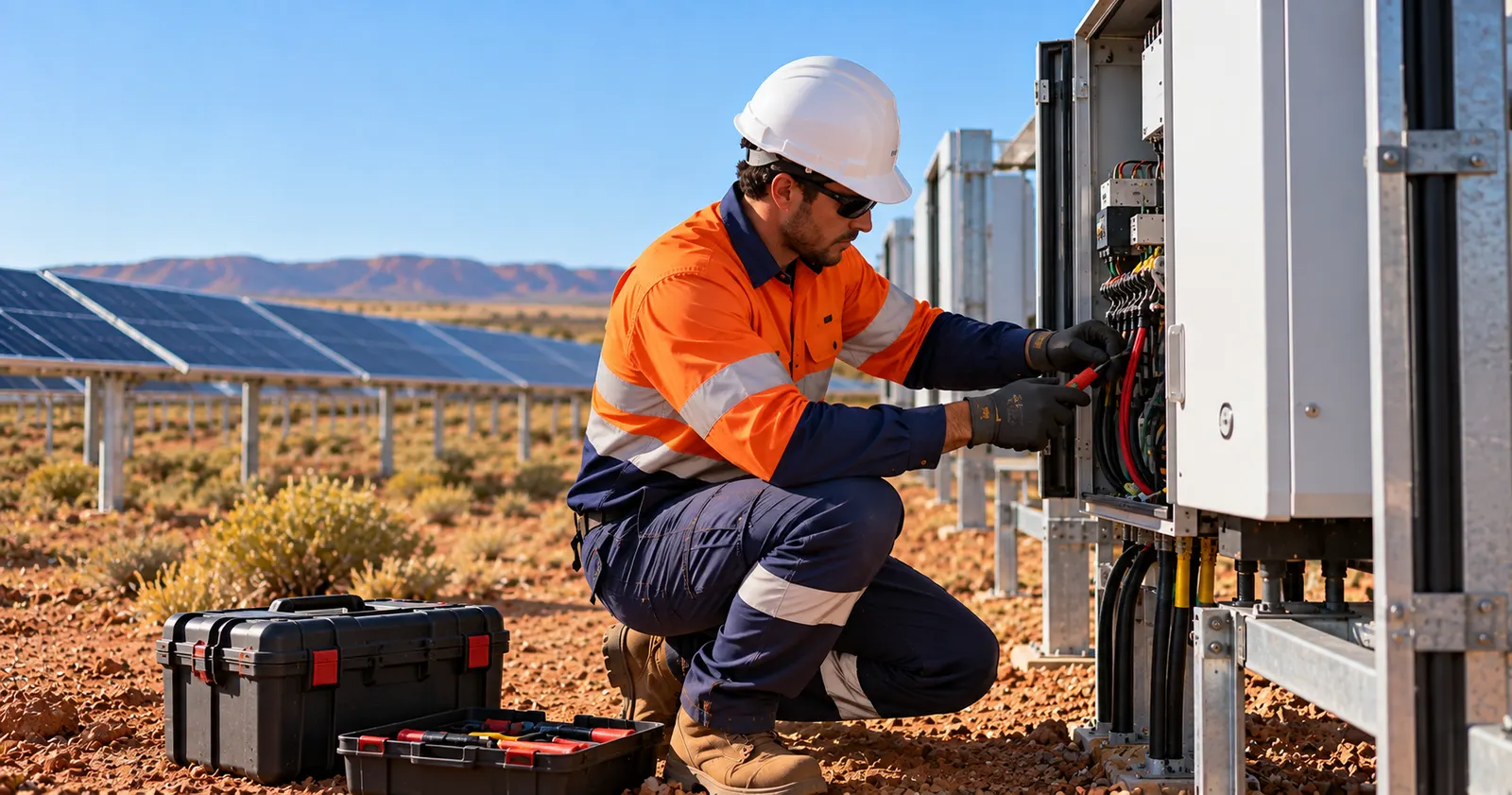
The DC side. Strings of modules, connectors, string harnesses, combiners, and the cabling that carries all of it to the inverter stations. This is the highest-volume work on the site and it is repetitive by design: the same termination, thousands of times, to a standard that has to hold for decades in weather. Quality is a numbers game here — a defect rate that would be invisible in a house is a fault-finding exercise across a hundred hectares.
The AC side and the inverter stations. Inverter or power conversion stations sit through the array, stepping up and converting, each one a small substation with its own protection, auxiliaries and controls. This is where the work starts feeling like industrial electrical work rather than volume installation.
The high voltage side and the connection. The site substation, the transformers, the switchgear and the connection to the transmission network. Far fewer people, far more paperwork, and access controlled by authorisation rather than by licence alone.
Around all three sits testing and commissioning: insulation resistance, polarity, continuity, string performance, protection settings, then energisation block by block until the farm is handed over. Solar farm construction jobs places these in the project's four phases, which is worth reading because it tells you when each is being staffed.
Licensing is a State matter, and that is the first thing to check
Electrical licensing in Australia is issued and policed by State and Territory regulators. Every one of the seven electrical roles published on this board in August 2026 required an electrical licence, and no employer on a construction site of this kind has any discretion about it.
Three situations, three different questions to ask the regulator rather than a recruiter:
- You hold a licence in one State and the project is in another. There are mutual recognition arrangements for occupational licensing in Australia, and the practical steps are set by the regulator in the State you are going to. Ask before you accept a roster, not after.
- You trained overseas. Recognition is a formal process, it takes time, and it is run by the same State regulators. It is not something an employer can shortcut and it is not something to start the week you arrive.
- You are an apprentice or a trade assistant. You work under supervision and within the limits your training contract sets. Solar builds are a common and genuinely good place to do that, because the volume of repetitive terminations builds real speed.
High voltage is an authorisation, not a line on your licence
This is the single most misunderstood thing about the trade on these sites. Working on or near high voltage apparatus, and switching it, is controlled by the asset owner's or contractor's authorisation system: a named person, assessed and appointed for defined operations on defined equipment, working to a permit. A licence is a prerequisite for it and is nowhere near sufficient.
What that means in practice for someone arriving:
- You will not be doing HV switching in your first month, however long you have been an electrician. Authorisation is granted after assessment, on that site's system.
- The HV roles are few and the paperwork is heavy. Access permits, isolations, test before touch, earthing, and a discipline about the sequence that is not negotiable.
- It is the most durable specialisation on this page. HV authorisation and substation experience travel to every other kind of energy project — wind, storage, network — and they are not tied to solar at all.
The one thing building work does not prepare you for
You cannot switch off the array. A module in daylight is a source. Isolating the AC side does not de-energise the DC side, strings sit at hundreds of volts DC, and DC arcs do not self-extinguish the way an AC arc does. Every safe system of work on the DC side of a solar farm is built around that fact, and it is the fact that catches people whose instincts were formed in a building where isolation means dead.
Four other differences that matter day to day:
- Scale changes what a small error costs. A wrong torque or a poor crimp repeated across a section becomes a fault-finding campaign in the sun.
- You work at height and in the open. Six of the seven electrical listings in August 2026 asked for working at heights, three for low voltage rescue, one for a CPR certificate and one for an electrical spotter ticket. Those tickets travel with the licence on this kind of site rather than being extras. Tickets for solar farm jobs goes through the whole list.
- The environment is the job. Heat, dust, UV, snakes, mud after rain and a site that is kilometres end to end. Working on a solar farm in Australia is the honest description of a day.
- The project ends. Electrical crews arrive later than civil ones and stay through commissioning, then move to the next build. That is the industry's normal shape.
What it was advertised at, and what that figure is not
The seven electrical roles published on this board, queried on 17 August 2026, advertised between AUD 58.00 and AUD 96.00 an hour. That is the widest band of any trade on the board, and the width is the information: the bottom of it is assistant-adjacent work on the DC side and the top is authorised, specialised or supervisory work.
That range is what these employers wrote on one day on this board. It is not a market average, it is not what you will be offered, and it does not tell you which of the many things a rate can include — allowances, penalties, travel, camp — is inside it. What solar farm jobs pay takes that apart properly, and trades, pay and tickets on utility-scale solar sets electrical work beside the other trades.
Where to look, and what to read on a listing
Electrical roles on this board are filterable by State, and the ticket list on each listing is the requirement — read it before the salary. Two questions worth asking before you accept anything: which phase the site is in, and whether the role is DC installation, station work or commissioning. Those three are different jobs sharing one job title.
If you are earlier on the ladder, career progression on solar farms sets out how people reach this branch from labouring and trade assistant work.
General information only. Electrical licensing, high voltage authorisation, mutual recognition and overseas qualification assessment are set by State and Territory regulators and by the asset owner's own safety system, and they change. Nothing here is a substitute for what a regulator publishes or what a listing declares. For pay and conditions, the national source is fairwork.gov.au.
Read next
Trades and careers
Plant operator work on a solar farm: which machine, which phase, which ticket
Trades and careers
Career progression on solar farms: the rungs, the forks and what each one is paid
Jobs by trade
Every Electrician opening
Articles