
The solar industry
The solar industry
Solar farm construction jobs: the four phases and when each trade is wanted
Civil, mechanical, electrical, commissioning: what each phase of a solar farm build does, which trades it calls for, and how to read a project’s status before you apply.
A solar farm is not staffed; it is staffed four times. A build runs through phases, each phase wants different trades, and when one finishes its crew leaves and another arrives. That is why a project advertising nothing in your trade one month can be advertising for it the next, and why "are they hiring?" is a less useful question than "what phase are they in?".
The four phases are civil, mechanical, electrical and commissioning. They overlap at the edges and they never run backwards. This article sets out what each one does, which trades it calls for, and what that means for when your application is worth sending. None of it happens on a roof: rooftop installation is a different industry, and this board does not list it.
Before any of it: the phases that hire nobody
A project spends years being a project before it is a construction site. On this board's project pages, a solar farm carries a status, and the first three of them employ almost no construction workers at all.
Announced. A developer has named a site and a capacity. Land agreements, grid connection studies and planning approvals are ahead of it. Nothing is built and nothing is hired.
Approved. Planning consent exists. Still no construction.
Financed. The money is committed and the contractor is being appointed. This is the last quiet phase, and it is the one worth watching: mobilisation follows it.
Then construction begins, and the four phases below are what "construction" actually means. After them the status becomes commissioning and then operating — and an operating farm has a small permanent team, measured in a handful of people rather than the hundreds who built it.
Phase one — CIVIL: earthworks, structures, site preparation
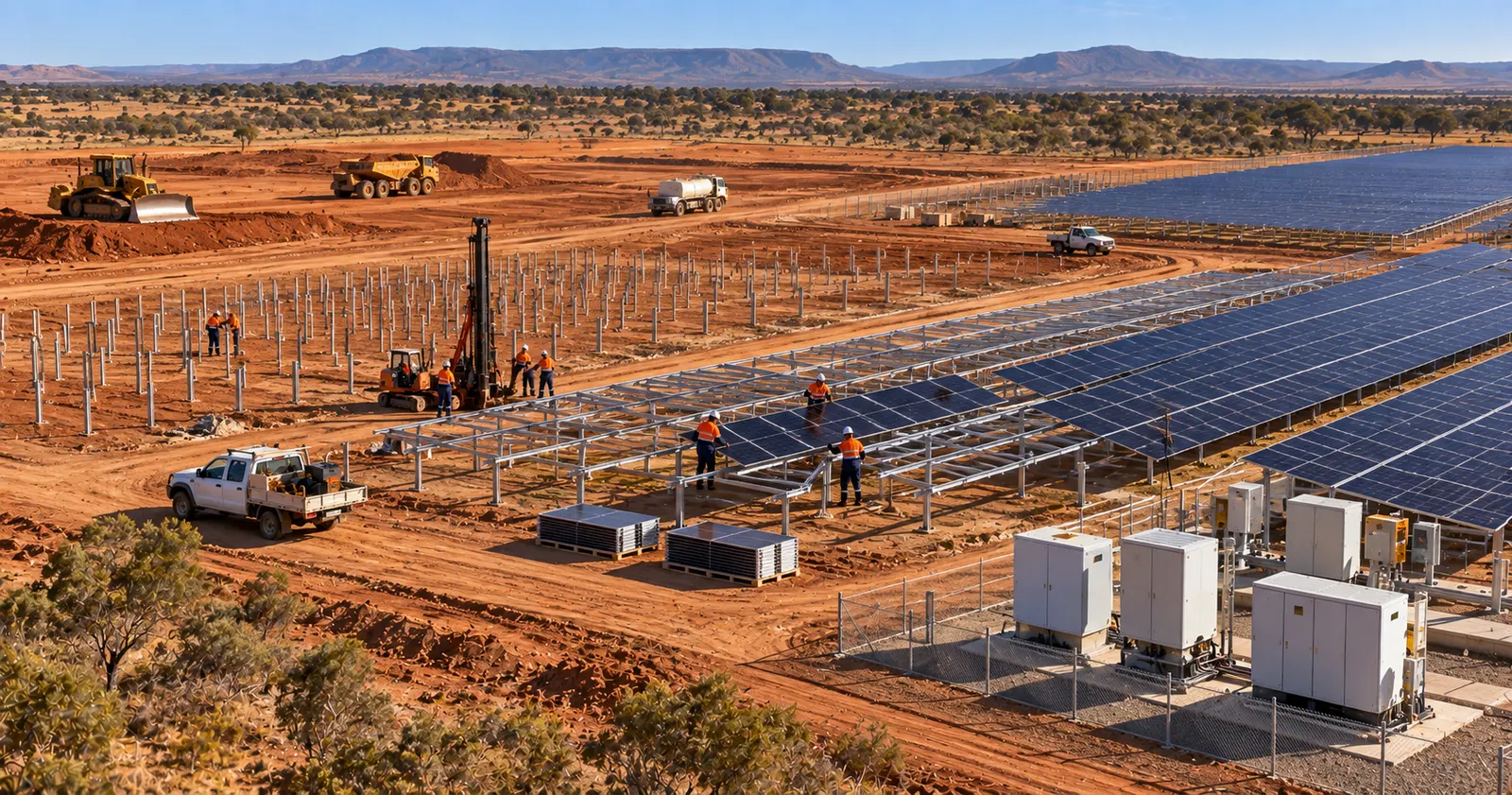
The first crews on site are not solar workers in any recognisable sense. They are a civil construction crew doing what a civil construction crew does anywhere: clearing and grading, building the internal access tracks, cutting drainage, putting in the site compound and the security fence, and then driving the thousands of steel piles that everything else will be bolted to.
Who is wanted. Plant operators above all — excavators, graders, skid steers, water carts, and the specialised piling rigs that set the tracker foundations. Alongside them, labourers for fencing, survey support, traffic control inside the site and general civil work, and supervision for the earthworks and piling crews.
What it feels like. Dust, machinery movements, and the largest single safety exposure on the build. Traffic management inside an active earthworks site is a real job here, not a formality.
Weather is a factor in a way it is not later. Rain stops earthworks. Stand-down clauses appear most often on civil-phase listings for exactly that reason.
Phase two — MECHANICAL: assembly, modules, trackers
This is the phase with the biggest headcount, and it is the reason a solar build is a mass employer at all. On the piles now in the ground, crews assemble the tracker structures — bearings, torque tubes, drive units — and then the modules are carried out row by row and bolted on, in an order set by a delivery schedule and a progress target.
Who is wanted. Labourers in the largest numbers of the whole project: unloading and distributing modules, installing them, torquing structures, and the sheer physical logistics of moving hundreds of thousands of components across a site — the labourer's job on a solar farm, set out task by task. Trade assistants paired with mechanical fitters, and plant operators on telehandlers keeping the crews supplied. Supervision multiplies here too, because the work is a repeated operation done to a torque specification across many crews at once.
It is the phase most people's first solar job is in. Repetitive, physical, learnable in days, and the family that most often takes people with no previous solar experience. If that is you, Solar farm jobs with no experience is written for this moment.
It is also the phase that ends. A mechanical crew's work finishes when the last row is installed, and the crew demobilises. That is not a reflection on anybody's performance; it is how a construction schedule works.
Phase three — ELECTRICAL: cabling, terminations, testing
Electrical work starts before mechanical finishes — the first blocks are being cabled while the last are still being bolted — and it becomes the site's centre of gravity as the array fills. DC strings are terminated and tested, combiner boxes and inverter stations are wired, medium and high voltage cable is pulled and jointed, and the substation is built out.
Who is wanted. Electricians, in the licensing your state requires, and increasingly the specialised end of the trade: cable jointers, high voltage workers, and test-and-inspect personnel. Trade assistants on the electrical side — cable pulling and string dressing are two-person jobs. Supervision with electrical background, because the paperwork here is a legal record rather than a progress note.
The paperwork is the deliverable. Every block handed over carries test records against an inspection and test plan. An electrician on a solar build spends a real fraction of the week recording what they tested, and a crew that cannot produce records has not finished the work.
Phase four — COMMISSIONING: energisation and handover
The last phase is the smallest crew and the highest stakes. Blocks are energised in sequence, protection systems are proven, the farm is tested against the connection agreement and the grid operator's requirements, defects found in testing are chased down and closed out, and the asset is handed to the operator.
Who is wanted. Commissioning electricians and test technicians, a small number of specialists, and supervision with a commissioning background. Labouring and mechanical numbers on site are a fraction of what they were three months earlier.
The board files this as a project status. A farm in commissioning is one where the mechanical hiring has already happened and the electrical hiring is thinning. If you are a labourer reading a project page that says commissioning, the useful conclusion is to look at which projects are earlier in the sequence.
Using this when you look for work
The phases turn a job search from a guess into a reading exercise.
Read the project status before the listing. Each project page carries its status, its state and its town. A project in construction with mechanical work ahead of it is a different prospect for a labourer than one in commissioning. The town is not an accident either: where the farms get built follows the sun, the land and the transmission line, and it is a map question before it is a jobs question.
Read the listing title for its phase. "Piling rig operator" is civil. "Tracker installer" and "module installer" are mechanical. "Cable jointer" and "commissioning electrician" are the last two phases. The vocabulary is consistent across the industry, and it tells you where a site is up to.
Expect the sequence, not a single job. People who work on solar builds long-term follow the phase they are good at from project to project. Knowing that the mechanical phase of one build finishes around when another one's begins is the whole skill, and it is why so much of this work travels by word of mouth.
Then read what is actually open. The board is the current state of it, filterable by trade and by state, and Working on a solar farm in Australia covers what any of these phases is like to live rather than to plan.
General information only. Phase names, sequences and crew compositions vary between contractors and between projects; this article describes the pattern the industry uses, not a commitment by any employer. Licensing and induction requirements are set by each state and territory. For pay and conditions, the national source is fairwork.gov.au.