
The solar industry
The solar industry
Solar panels jobs in Australia: rooftop installation is not utility-scale
The phrase covers two industries that share a component and almost nothing else. What a rooftop job actually is, what a solar farm job actually is, and which of the two this board lists.
"Solar panels jobs" is one phrase covering two industries that share a component and almost nothing else. One of them puts panels on roofs, house by house, in and around the cities. The other builds solar farms — hundreds of thousands of panels at a time, in a paddock, six hours from anywhere. The tickets are different, the crews are different, the rosters are different, and the way you get hired is different.
This article is about telling them apart, because searching for one and applying to the other is the most common wasted week in this industry. This board lists the second kind only, and it says so here rather than letting you find out at the end of an application.
Two industries, one phrase
The component is the same. The work is not.
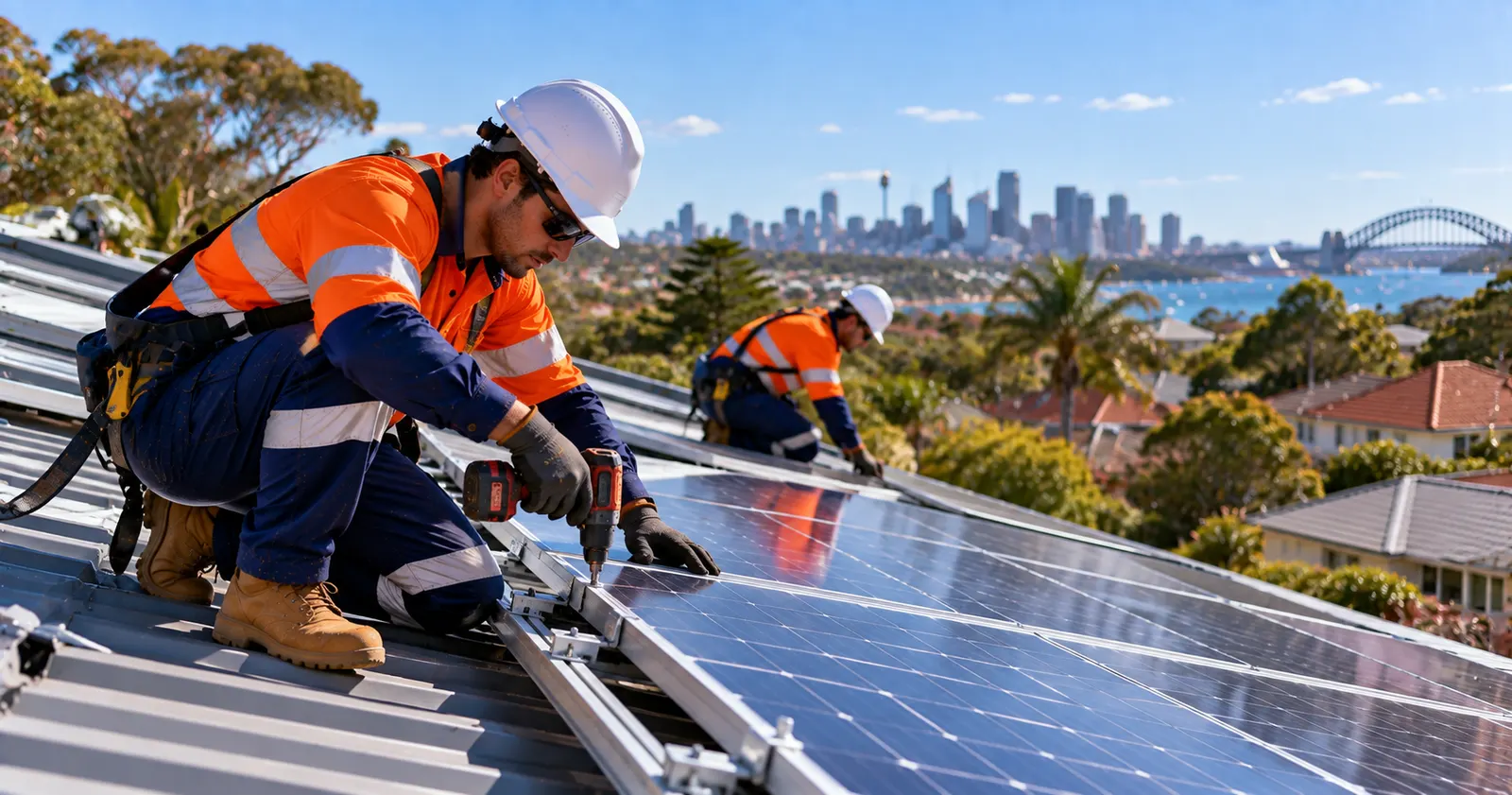
Rooftop and residential solar is an electrical trade business. A crew of two or three arrives at a house or a small commercial building in the morning, installs a system on the roof, connects it, tests it, files the paperwork with the network operator, and drives to the next one. The crew is usually a licensed electrician plus an installer or an apprentice. The work is local, the day ends at home, and the volume is measured in systems per week.
Utility-scale solar is a construction project. A single farm is a fenced site of several hundred hectares carrying rows of steel mounting structures, the panels bolted onto them, kilometres of cable, inverter stations and a substation that connects the whole thing to the transmission network. It is built by a contractor with a crew of dozens to hundreds of people, over a period of many months, on a schedule that moves in phases.
The second one is what this site is about, and it is the one almost nobody searches for by its right name.
What a rooftop job actually is
Worth stating plainly, because it is a real career and this page is not arguing against it.
Rooftop work is electrical-trade work first. The person who connects a system to a building's supply and to the grid is doing licensed electrical work, and the licensing is set by the state or territory the building is in. Around that role sit installer and labouring positions, and there are accreditation schemes specific to the sector that employers and rebate programs ask for on top of the electrical licence.
What defines the job from a worker's point of view:
- You sleep at home. Rooftop crews work out of a depot in or near a city and drive to jobs. There is no camp and no roster.
- Heights and confined roof spaces every day. Working at heights training is not a formality here, it is the job.
- Small crews, high job count. Several sites a week, sometimes several a day, each with its own access, its own switchboard and its own surprises.
- The trade is the qualification. Progression runs through the electrical trade rather than through construction supervision.
If that is the work you want, the places to look are electrical contractors and installation companies in the capital cities. It is not what is advertised here.
What a solar farm job actually is
A utility-scale build is a civil and mechanical construction job that happens to end in an electrical one. The panel is the last thing to arrive and the smallest part of the effort.
The shape of the work, in the order a site does it: survey and earthworks, then thousands of steel piles driven into the ground, then the tracker structures assembled onto those piles, then the modules carried out and bolted on, then the cabling, terminations and testing, then commissioning block by block until the farm is energised and handed over. Our guide Working on a solar farm in Australia walks through what that means for a day on site, and Solar farm construction jobs sets out the four phases and which trades each one calls for.
What defines the job from a worker's point of view:
- It is regional. The array is where the land and the transmission line are, which is rarely near a city. Of the listings published on this board in August 2026, every one is in a regional area, across 25 towns.
- You live near it or you fly to it. Camp, a room in town, an allowance, or fly-in fly-out. On the same August 2026 listings, 12 quoted a camp, 4 were fly-in fly-out, 7 quoted an allowance and 6 offered nothing on accommodation at all.
- Rosters, not weeks. 5 days on and 2 off if the crew is local; 10 and 4, 14 and 7 or two weeks on and one off if it is not.
- Most of the headcount is not electrical. The largest crews on a solar build are labourers, trade assistants and plant operators.
- The project ends. A build has a finish date, and the crew moves to the next one. That is the industry's normal shape, not a warning sign.
Which one are you looking for?
Three questions settle it faster than any job title.
Do you hold, or want, an electrical licence? If the licence is the centre of your plan, both industries want you, and rooftop work will keep you in a city while solar farms will not. If you do not hold one and are not training towards one, rooftop crews have few positions for you and a solar farm build has many.
Can you be away from home? This is the real dividing line. A solar farm job means living in a regional town, in a camp, or on a flight roster. If the answer is no and you are not already living near a build, rooftop is the sector that fits your life.
Do you want to be on one site for months, or on five sites a week? Both are a preference, neither is better, and they are genuinely different jobs.
What this board lists, in its own words
Every listing here is filed under one of five occupations, and reading them is the quickest way to see what the sector really hires for.
- Labourer — unloading and installing modules, torquing structures, fencing, traffic control inside the array. The largest group on almost every build, and the family that most often takes people with no previous solar experience.
- Trade assistant — paired with a mechanical or electrical tradesperson, doing the work that supports theirs. A common route from labouring into a trade.
- Plant operator — telehandlers, excavators, skid steers, water carts, piling rigs. Ticketed work, and the tickets have to be current.
- Electrician — DC string work, combiners and inverters, medium and high voltage, commissioning and the test records that go with each block.
- Supervision — leading hands and supervisors, usually salaried rather than hourly.
There is no rooftop installation category, and there will not be one. A board that filed residential work next to utility-scale construction would be telling both audiences something untrue about the other.
Where to go from here
If the utility-scale side is what you are after, three pages carry the substance: Solar farm jobs with no experience if this would be your first construction job, Trades, pay and tickets for the credentials each family asks for, and the full board for what is open right now. The projects map shows where the builds themselves are.
General information only. Electrical licensing, high risk work licences and construction induction are set by each state and territory, and they differ. Check the regulator for the state you will actually work in. For pay, work rights and conditions, the national source is fairwork.gov.au.