
Life on site
Life on site
Working on a solar farm around Dubbo and western New South Wales: distances, towns and rosters
From the central west out to the far west, New South Wales runs a long way inland. What it is like to live and work on a solar build across that country — the towns, the heat, the housing squeeze, the driving — and what this board is carrying for the State.
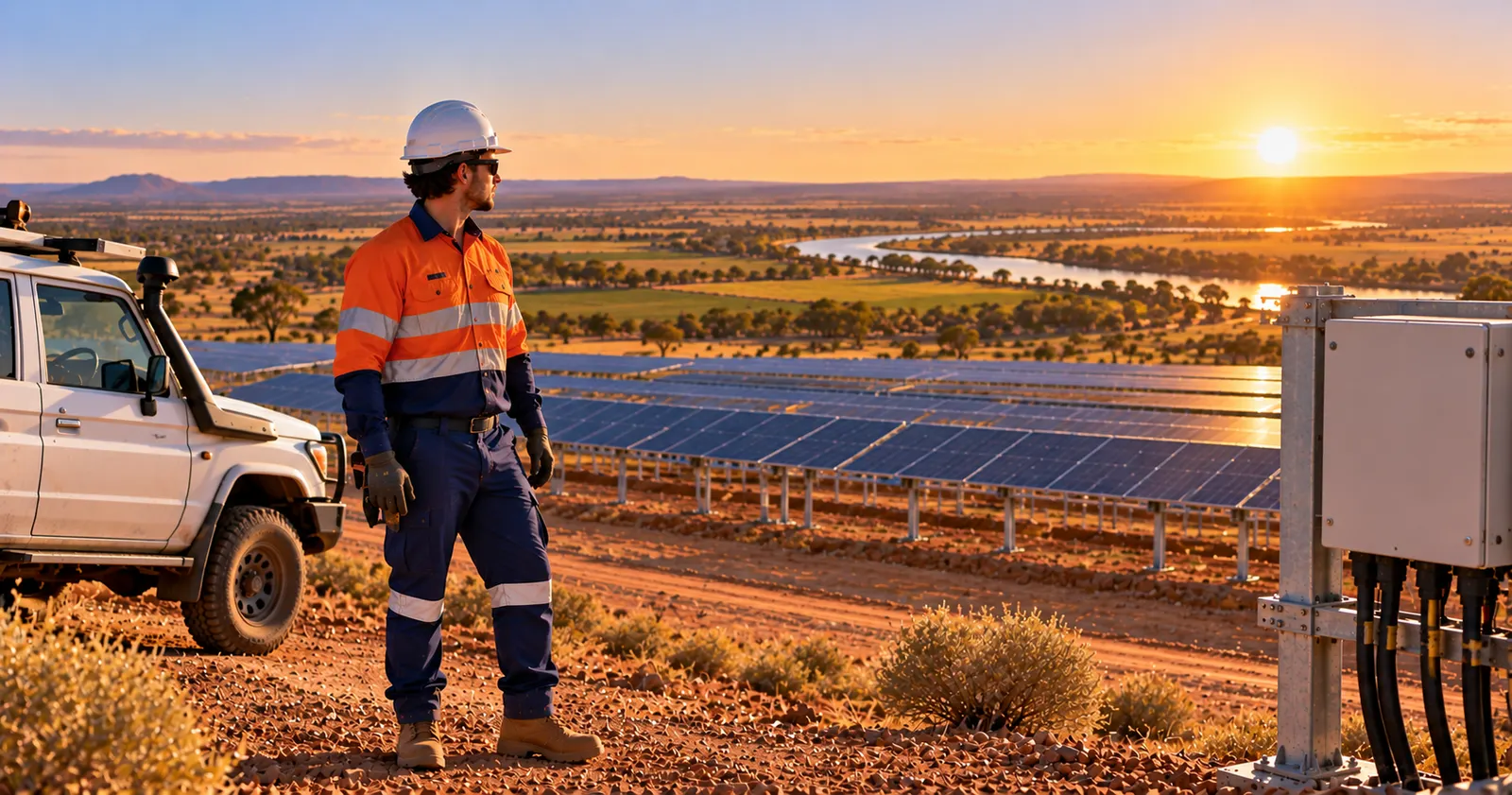
New South Wales is much wider than the coast suggests. Drive inland from Sydney, over the range and out past Dubbo, and the country opens into grain, sheep and irrigation, then into genuine dry country before the South Australian border. Solar construction happens across that whole span, and what the work is like depends a great deal on where in it you land.
This article is about living and working out there: which towns you actually end up in, what the driving really means, what the housing does when a build is on, and how a roster is shaped by distance. The openings themselves are on the New South Wales listings.
One State, three kinds of country
The listings this board has carried for New South Wales fall into three bands, and they are three different experiences.
The central west — Dubbo and around. Dubbo is a substantial regional city with a hospital, an airport, trades, schools and a rental market that behaves like a city's. Towns in its orbit, Wellington among them, are small but well connected to it. If you are new to regional work and you get a placement in this band, you have landed softly: services are close, the drive to Sydney is long but ordinary, and there is a normal life available on your days off.
The Riverina and the Murray — Wagga Wagga, Hay, Balranald. Irrigated farming country, flat, with long straight roads between towns of very different sizes. Wagga Wagga is a city; Hay and Balranald are small towns where a construction crew is a visible share of everyone in town for the duration of a build. Follow the Murray downstream from Balranald and the country turns into the Sunraysia, whose centre is Mildura on the Victorian bank: solar farm jobs in Mildura and the Sunraysia is the guide for that end of the river, Wentworth included.
The far west — Broken Hill and beyond. This is arid country and it is a different proposition entirely. Broken Hill is a mining city with a long history of doing exactly this — housing, feeding and rostering a technical workforce a long way from anywhere — and that history is why it works. Everything around it is remote in the real sense.
The driving is the thing to take seriously
More than climate, more than housing, distance is what people underestimate in western New South Wales. Three practical consequences.
Site is not in town. A solar build sits on farmland, which means a commute out of whatever town you sleep in, on roads that carry stock, road trains and wildlife. That drive at dawn and at dusk is the highest-risk part of a lot of people's working day, and it is why so many listings want a driver's licence regardless of the trade.
Between towns is a trip, not an errand. Getting from one of these towns to the next is a planned journey. It changes what "a night out" means, what a supply run means, and how you plan a weekend.
Fatigue is a roster design problem. A compressed swing followed by a long drive home is a known hazard and a good employer schedules around it. FIFO and DIDO on Australian solar builds sets out how those roster patterns work and what to ask about travel time.
Heat, cold mornings and a very open sky
Inland New South Wales has a bigger temperature range than the coast in both directions, and a solar site has no shelter from either end of it.
Summer is hot, dry and long, and the working day is shaped around it: early starts, planned breaks, and heat procedures that are the employer's responsibility. Dry is the operative word: the humid heat of Chinchilla and the Western Downs is a different hazard with a different set of procedures. Winter mornings inland are genuinely cold, often frosty, and the first hour on site in July is a different kind of unpleasant from the January afternoon. Dust is constant on a dry site, and the glare off open ground and glass is real.
Working on a solar farm in Australia describes the day itself. What is specific to this part of the country is the spread: you may need both thermals and a hydration plan in the same posting.
Housing, and why the town's size decides everything
The housing question has a different answer in each of the three bands above.
In Dubbo or Wagga Wagga, a rental market exists and a build competes in it. It gets tight and it gets expensive, but there is a market. In a small town — Hay, Balranald, Wellington — there is essentially no slack: motels, caravan parks and a handful of houses, and a project that brings hundreds of people either houses them itself or discovers the problem publicly.
That is why what an employer provides is the first question to ask:
- A camp, with rooms and a mess, is the normal answer on larger and more remote builds.
- An allowance works if you already know the town and have somewhere to go.
- Nothing means the role is treated as local, which is a fine arrangement if you live there and a bad surprise if you do not.
Of the New South Wales listings published on this board in August 2026, eight of ten declared accommodation of some kind. That is a fact about those ten listings on that day rather than a rule about the State, and the accommodation field is on every listing page for exactly this reason.
What this board was carrying for New South Wales
Queried on 17 August 2026, ten listings were published for New South Wales — the largest count of any State on the board that day. Two were at Dubbo, two at Wellington, two at Wagga Wagga, and one each at Hay, Balranald, Wentworth and Broken Hill.
The trade mix was four labouring roles, three electrical roles, one plant role, one trade assistant role and one supervision role. Eight of the ten quoted a rate by the hour, and those eight advertised between AUD 34.00 and AUD 92.00 an hour — a band that spans a first-day labouring rate and a licensed electrical role, written by these employers on one day, and not a market average. What solar farm jobs pay explains what is and is not inside a figure like that.
Five of the ten declared themselves eligible towards the 88 days, which was the highest count of any State on the board that day. The 88 days and solar farm work explains that condition; eligibility turns on the postcode, the industry and the arrangement, and the employer is the one who declares it.
The electrical share is worth noting on its own: three of the ten roles were electrical, which is more than any other State carried that day. Electrician jobs on Australian solar farms is the article for that trade. The live list is always the New South Wales listings.
If you are heading out west
Confirm the bed before the job. In a small town it is the constraint, not a detail.
Have a vehicle and keep it serviced. You will do more kilometres in a fortnight out here than in a month in a city, on roads where a breakdown is not a five-minute inconvenience.
Hold the White Card before you arrive. Tickets for solar farm jobs covers what else is worth holding for the trade you are aiming at, and solar farm jobs with no experience is where to start if you have never been on a site.
Understand which band you are going to. Dubbo and Broken Hill are both "western New South Wales" and they are not the same posting. Read the town on the listing, not just the State.
General information only. Site rules, heat policies, accommodation arrangements and visa eligibility are set by employers and regulators and they change. Nothing here replaces what a listing declares. For pay and conditions, see fairwork.gov.au; for visa conditions, immi.homeaffairs.gov.au.