

Life on site
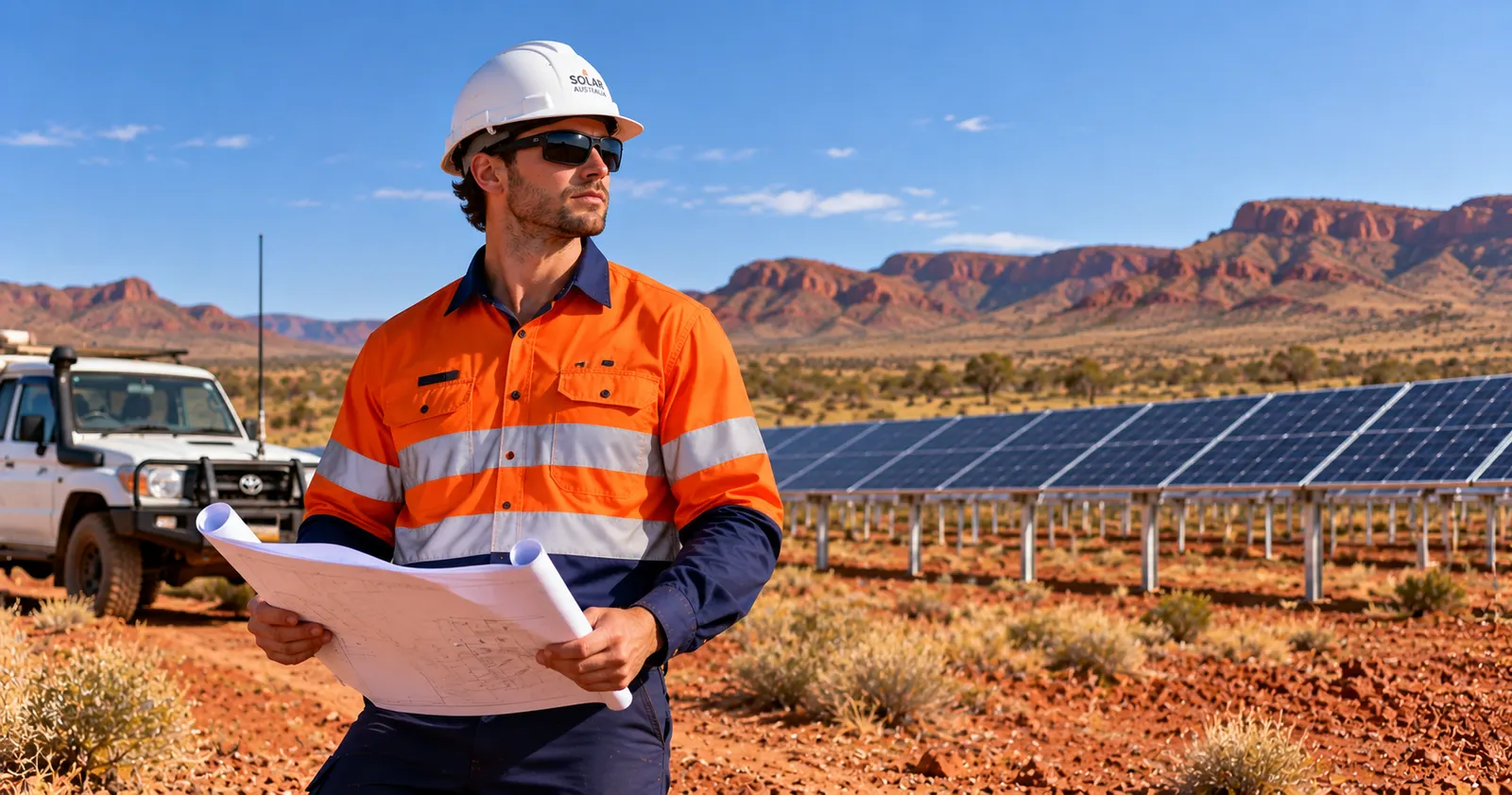
Life on site
Working on a solar farm in the Pilbara: Karratha, real remoteness and a mining roster culture
The Pilbara is hot, remote and industrial, and it runs on rosters. What it is like to live and work on a solar build in that part of Western Australia — the wet season, the camps, the fly-in fly-out norm — and what this board is carrying for the State.
The Pilbara is the most demanding place on this board and the one with the most developed answer to its own demands. It is hot, it is remote in a way that is difficult to convey until you have done the flight, and it is thoroughly industrial: iron ore, gas and ports have shaped the towns, the roads, the airports and above all the way people work.
Karratha is the coastal centre of it — a modern town built by industry, with an airport that runs like a commuter terminal at swing change. If you take work on a solar build up here, the work itself will be familiar to anyone who has been on a build elsewhere. Everything around the work will not be. What is open now, State-wide, is on the Western Australian listings.
Remoteness is not a figure of speech here
Three practical facts define the region for a worker.
Perth is a flight, not a drive. People do drive it, and it is a serious undertaking rather than a trip. For a rostered worker the plane is the normal answer, and that is why fly-in fly-out is the dominant pattern in the Pilbara rather than one option among several. The contrast is solar farm jobs around Port Augusta, where Adelaide is a long drive rather than a flight, and the rosters are shaped by that one difference.
Distances inside the region are large too. Karratha, the inland mining towns and the ports are separated by long stretches of road with very little in between. Vehicle preparation, water, fuel and telling someone your plan are ordinary habits here, not survivalism.
Services exist, and they are industrial-town services. Karratha has shops, medical services, sport and an airport. It is not a frontier settlement. It is also not a place you end up in by accident, and almost everyone there is there for work.
The other Western Australian towns this board has carried listings for show the spread: Kalgoorlie in the goldfields, deep inland and a mining city in its own right, then Northam and Merredin in the Wheatbelt, which are agricultural, much closer to Perth, and an entirely different proposition from the Pilbara.
Heat, and a wet season that stops work
The Pilbara has two seasons that matter to a construction programme.
The hot season is genuinely severe, humid on the coast, and it dictates everything about how a day is organised: very early starts, enforced rest and rotation, hydration monitored as a control rather than encouraged as a good idea, and scopes moved out of the middle of the day where they can be. Heat management here is a formal system with someone responsible for it, and if it is not, that tells you something about the contractor.
The wet season brings cyclone risk to the coast. Sites in this part of the country have cyclone procedures, securing plans and shutdown triggers, and a project's programme is built around the possibility of losing days. For you, the questions are: what happens to your roster during a shutdown, where do you sit it out, and how is standby paid.
The cooler months are the reason the region is a pleasant place to work for part of the year, and they are short. Working on a solar farm in Australia describes the day itself; the Pilbara version of that day is the same work with a much larger safety margin built around the weather.
Camps and rosters, and why they are not negotiable up here
The Pilbara has the most mature workforce accommodation system in the country, because the mining industry built one. Camps are normal, meals are usually included, rooms are usually single, and a solar project either uses an existing village or brings one. The Western Downs in Queensland has a camp industry of its own too, built by gas rather than iron ore, and it is a drive from Brisbane rather than a flight from Perth.
That is the good news, and the corollary is that the roster comes with it. Compressed swings — a long block of long days on site, then a block of days off at home — are the standard arrangement, with flights at the change of swing. It is a way of living, not just a way of working, and it suits some people extremely well and others not at all.
Two questions worth asking before you accept:
- Who pays for the flights, and from which airport? A point of hire that is not your home city changes the economics of the roster substantially.
- What is the roster, in numbers, and is it even time? The difference between roster patterns is the difference between a life and a grind, and it is a fair thing to ask about before rather than after.
Of the Western Australian listings published on this board in August 2026, six of six declared accommodation of some kind — a fact about those six listings on that day, and one that is entirely consistent with a State where the remote work has an accommodation industry attached to it. FIFO and DIDO on Australian solar builds is the article about what those rosters actually do to your pay and your time.
The work itself, and what transfers from mining
A solar build is a solar build wherever it is, and the trades and phases are the same ones described in solar farm construction jobs. What is specific here is the workforce around you: a large share of it will have come from resources, and the site culture reflects that.
What transfers from a mining site: the safety systems, the permit culture, the prestart discipline, the roster habits, the camp etiquette. Someone with resources experience will find a Pilbara solar site legible from day one, and that is a real advantage in getting hired.
What does not transfer: the scale of repetition. A solar build is a production line laid out over kilometres — piles, tables, modules, the same movement thousands of times — and the skill it rewards is consistency rather than problem-solving. People arriving from complex plant work sometimes underestimate that, and it is the thing to be honest with yourself about.
What this board was carrying for Western Australia
Queried on 17 August 2026, six listings were published for Western Australia. Two were at Karratha, two at Kalgoorlie, and one each at Northam and Merredin.
The trade mix was two labouring roles, one trade assistant role, one plant role, one electrical role and one supervision role. Five of the six quoted an hourly rate, and those five advertised between AUD 34.00 and AUD 84.00 an hour. It is what these employers wrote on one day, it is not a market average, and it does not tell you what a roster or a camp is worth on top. What solar farm jobs pay explains what a figure like that contains.
Three of the six declared themselves eligible towards the 88 days; the condition is set out in the 88 days and solar farm work and is declared by the employer rather than by the board.
Worth reading against those numbers: only two of the six Western Australian listings were in the Pilbara at all. The State's solar work is spread from the Wheatbelt to the goldfields to the coast, and "Western Australia" on a listing tells you much less than the town does. The live list is the Western Australian listings.
If you are going north
Take the heat seriously before you arrive. Arrive rested and hydrated, and expect your first swing in the hot season to be harder than you planned for. This is the one region where that advice is not a formality.
Read the roster and the point of hire together. They are one arrangement, and either one alone tells you very little.
Hold the White Card, and expect a thorough induction. Tickets for solar farm jobs covers what else is worth holding by trade, and if you have never been on a site, solar farm jobs with no experience is the honest starting point — although a remote camp-based build is rarely the easiest first job in the industry.
If you are coming from resources, say so plainly in your application. It is the most transferable background there is for this region, and career progression on solar farms sets out where it puts you on the ladder.
General information only. Heat and cyclone procedures, camp rules, licensing and visa eligibility are set by employers and by regulators and they change. Nothing here replaces what a listing declares. For pay and conditions, see fairwork.gov.au; for visa conditions, immi.homeaffairs.gov.au.